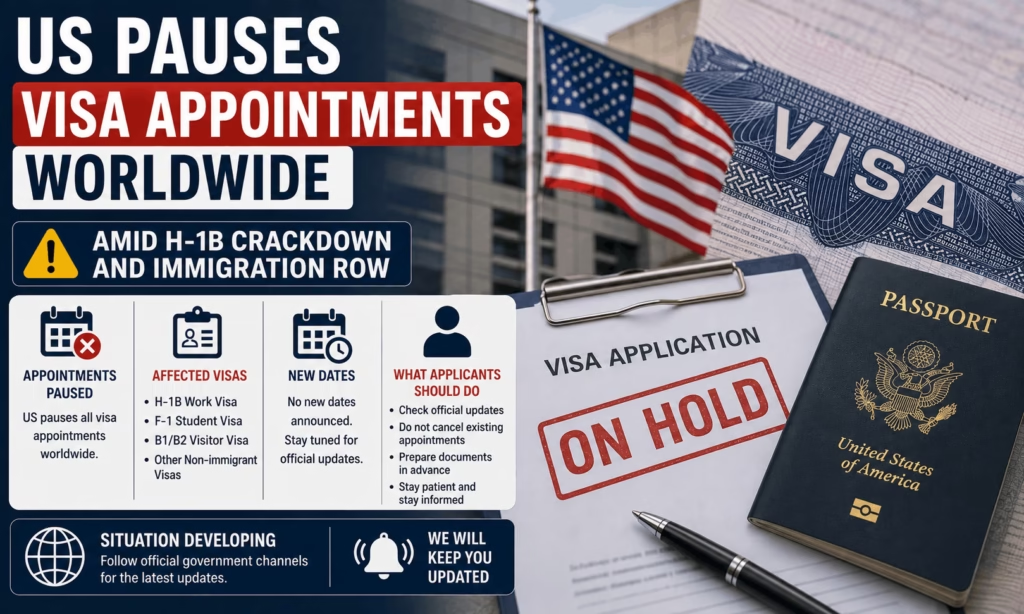
US Pauses Visa Appointments Worldwide: The United States has hit pause on visa appointments at its embassies and consulates around the globe, and the timing could not be more disruptive for millions of hopeful travelers, students, and skilled workers. On Tuesday, a State Department spokesperson confirmed that a new global training initiative for consular officers is now underway at every US mission worldwide, and appointment slots for visa services are being adjusted to make room for it. For applicants who spent weeks or months waiting for an interview slot, the news has landed as a fresh blow in an already tense year for US immigration policy.
The pause comes just days after a federal judge struck down a separate Trump administration policy that had suspended immigrant visa issuance for people from 75 countries, ruling that the move exceeded the legal authority of the Secretary of State. Coming so close together, the two developments have fueled speculation that Washington is recalibrating its vetting system in real time, even as legal challenges pile up. Applicants with immigrant visa interviews already on the calendar have reportedly received emails informing them that their appointments are being rescheduled, with no fixed date yet given for when they will be seen. We will be updating this article monthly as new details, timelines, and visa bulletin dates are confirmed by the State Department.
US Visa Appointment Pause 2026 Key Highlights
| Detail | Information |
|---|---|
| Announcement date | Tuesday, August 25, 2026 |
| Announced by | US Department of State spokesperson |
| Scope | All US embassies and consulates worldwide |
| Reason cited | Global training initiative for consular officers |
| Visa categories affected | Immigrant visas confirmed; nonimmigrant visa impact still being assessed |
| Related court ruling | Federal judge blocked the 75-country immigrant visa pause on Friday, August 21, 2026 |
| Stated goal of training | Screening applicants likely to depend on US public benefits |
| Backdrop | Ongoing H-1B crackdown, Project Firewall investigations, and $100,000 H-1B proclamation fee |
| Who is affected | Immigrant visa applicants, family sponsorship cases, and potentially work visa applicants including H-1B |
| Current status | Appointments being rescheduled; new dates to be issued directly to applicants |
The News Hook: Why This Matters Right Now
If you had a visa interview booked at a US consulate this week, there is a real chance it has already been moved. This is not a routine embassy closure or a single-country restriction. It is a coordinated, worldwide adjustment to how consular officers handle applications, rolled out with almost no advance public notice. For families waiting years for a green card interview, for skilled workers hoping to start a new job, and for students planning a semester abroad, even a short delay can mean missed deadlines, lost tuition deposits, or an employer pulling an offer.
The US visa appointment pause also cannot be separated from the broader immigration story unfolding this year. It follows a pattern that started with the September 2025 proclamation imposing a steep $100,000 fee on new H-1B petitions, continued through investigations into visa sponsorship abuse under a program known as Project Firewall, and escalated further in January 2026 when the State Department attempted to block immigrant visa issuance from 75 countries altogether. That policy was thrown out in court just last week. Now, instead of a single country-specific order, the administration has opted for a global operational pause tied to staff training, a move that gives it more flexibility while sidestepping the exact legal argument that sank the previous policy.
What the State Department Has Said
A State Department spokesperson described the move as a training exercise rather than a formal policy suspension. According to the department, the goal of the training is to help consular officers evaluate visa applicants “comprehensively and consistently,” with particular attention to identifying applicants deemed likely to become dependent on US public benefits after arrival. Officials have not released a timeline for how long the training will last or when normal scheduling will resume, and no country-by-country breakdown has been published.
This ambiguity is itself part of the story. Because the pause was announced as an internal training matter rather than a formal rule change, it does not require the same public notice-and-comment process or legal justification that a rule under the Immigration and Nationality Act would need. That has allowed the administration to adjust visa operations quickly, but it has also left applicants, immigration attorneys, and even some consular staff without clear guidance on what happens next.
Public Charge Policy 2026: USCIS Issues Sweeping New Guidance Effective September 18
Background: A Year of Escalating Immigration Actions
To understand why this pause has generated so much attention, it helps to look at the sequence of actions that preceded it.
In September 2025, a presidential proclamation restricted entry for certain H-1B nonimmigrant workers outside the United States unless their employer paid a new $100,000 supplemental fee per petition, or the worker received a national interest waiver. The move was aimed squarely at the H-1B program, which for years has sent roughly seventy percent of its visas to nationals of India, with the rest going largely to applicants from China and other countries with large technology and engineering workforces.
By November 2025, the administration had launched Project Firewall, a sweeping enforcement effort involving more than 175 investigations into companies suspected of misusing the H-1B program. The initiative targeted employers in IT services, engineering, and healthcare staffing, arguing that some firms were exploiting the visa system rather than genuinely addressing a shortage of American talent. The crackdown quickly drew legal pushback, including a lawsuit from the US Chamber of Commerce, and criticism from members of Congress who warned that the restrictions could damage the US-India relationship and slow down American competitiveness in artificial intelligence and technology.
Then came January 2026. On January 14, the State Department announced it would pause immigrant visa issuance to nationals of 75 countries, citing concerns that migrants from those countries were more likely to rely on US public assistance programs. The list covered close to forty percent of the world’s countries, from Afghanistan, Somalia, and Syria to Brazil, Nigeria, and Russia. The pause did not affect nonimmigrant categories like tourist, student, or H-1B visas, but it froze the path to permanent residency for hundreds of thousands of applicants who had already cleared earlier stages of the immigration process, in some cases after years of waiting.
That policy was challenged in federal court, and on Friday, August 21, 2026, US District Judge Jeanette Vargas ruled against the administration in a 61-page decision, finding that the blanket pause was contrary to law and exceeded the statutory authority granted to the Secretary of State. The ruling was seen as a significant setback for the administration’s immigration strategy, and it set the stage for this week’s announcement of a new, broader pause dressed as a training initiative rather than a formal visa ban.
How the New Pause Differs From the 75-Country Ban
There are a few important distinctions between the policy that was struck down and the pause announced this week.
First, scope. The 75-country pause targeted specific nationalities based on a public charge rationale. The new pause applies globally, to every US embassy and consulate, regardless of nationality, at least for the training period.
Second, legal framing. The earlier policy was structured as an outright refusal to issue immigrant visas under existing law, which the court found exceeded the Secretary of State’s authority. The new pause is framed as an operational and training matter affecting appointment scheduling, not a change to who is eligible for a visa. This framing may make it harder to challenge in court using the same legal theory that succeeded last week, since no formal rule or visa refusal is technically being implemented.
Third, duration. The 75-country pause was described as indefinite, pending a reassessment of vetting procedures. The new global pause is also open-ended in practice, since the State Department has not committed to a specific end date for the training.
Impact on H-1B and Other Work Visa Applicants
While the State Department’s public comments have focused on immigrant visa applicants, the timing has raised concerns among H-1B workers and their employers as well. The H-1B visa crackdown has already caused significant disruption over the past year, including mass rescheduling of interview appointments in India that began in December 2025 as part of expanded social media vetting for H-1B and H-4 applicants. Immigration attorneys have reported that some H-1B interview appointments originally scheduled for January 2026 were pushed as far out as September 2026, and in a handful of cases, into 2027.
Employers sponsoring H-1B workers should expect continued unpredictability in the near term. Companies with employees currently outside the United States on approved H-1B petitions, particularly those who traveled home for stamping or renewal, may face extended waits before their staff can return to US worksites. Immigration lawyers are advising clients to avoid unnecessary international travel until there is more clarity on how long the current pause will last and whether nonimmigrant categories will be affected beyond the vetting delays already in place.
IRS Notice 2026-28: New Paid Family Leave Employer Credit Rules
Who Is Affected by the Visa Appointment Pause
- Immigrant visa applicants with interviews scheduled at any US embassy or consulate worldwide
- Family-sponsored green card applicants waiting on priority dates from the monthly Visa Bulletin
- Diversity Visa Lottery selectees whose interviews fall within the pause window
- H-1B and H-4 visa holders already facing enhanced vetting delays, particularly in India
- Employment-based immigrant visa applicants, including those sponsored through PERM labor certification
- Family members applying through consular processing rather than adjustment of status inside the United States
Applicants already inside the United States who are adjusting status through USCIS rather than through a consulate abroad are generally not affected by this particular pause, since it applies to consular visa services rather than domestic USCIS processing.
How to Check Your Visa Appointment Status
- Log in to your CEAC or ImmiVisa account. Immigrant visa applicants should check the status of their case directly through the Consular Electronic Application Center to see if a rescheduling notice has been posted.
- Check your email, including spam folders. The State Department has confirmed that affected applicants are being notified by email if their appointment has been rescheduled.
- Visit your specific embassy or consulate website. Operating status can vary by location, and individual missions may post updates faster than the main State Department site.
- Contact your visa service provider if applicable. In countries where a third-party visa application center handles scheduling, check with that provider for the latest local guidance.
- Consult an immigration attorney for time-sensitive cases. If your visa is tied to a job start date, school enrollment, or a expiring petition, professional guidance can help you understand your options while the pause continues.
Processing Time and Payment Schedule Considerations
Because this pause affects appointment scheduling rather than fee payment or application submission, applicants who have already paid visa fees do not need to repay them when their interview is rescheduled. However, processing times across affected posts are expected to lengthen in the near term, particularly at consulates that already carried a backlog from the 2025 vetting expansion. Applicants should build in extra buffer time for any visa-dependent plans, including job start dates, university enrollment deadlines, and family travel plans, until the State Department issues updated processing time estimates.
Social Security Compassionate Allowances List: 14 Conditions Added
2027 Social Security COLA: 3.6% Estimate Beats Medicare Hike
Official Resources
| Resource | Purpose | Official Link |
|---|---|---|
| US Department of State, Bureau of Consular Affairs | Visa news, appointment updates, and country-specific guidance | travel.state.gov |
| Consular Electronic Application Center (CEAC) | Check immigrant visa case status | ceac.state.gov |
| USCIS Case Status Online | Check status of underlying petitions such as I-130 or I-140 | uscis.gov/casestatus |
| Visa Bulletin | Monthly priority date movement for family and employment categories | travel.state.gov/visabulletin |
| US Embassy and Consulate Locator | Find contact details for your specific consular post | usembassy.gov |
FAQs
Has the US stopped issuing visas completely?
No. The current pause affects the scheduling of visa appointments as part of a global training initiative for consular officers. It is not a formal ban on visa issuance, and applicants with previously issued valid visas are not affected.
Why did the US pause visa appointments in August 2026?
The State Department cited a global training initiative aimed at helping consular officers evaluate visa applicants more consistently, including screening for applicants deemed likely to depend on US public benefits. The pause follows a federal court ruling that struck down a related 75-country immigrant visa ban.
Does this pause affect H-1B visa holders?
The State Department has not specifically named H-1B visas as part of this pause, but H-1B and H-4 applicants have already been dealing with significant appointment delays since December 2025 due to expanded social media vetting, and further disruption is possible while the new training initiative is in effect.
How long will the visa appointment pause last?
The State Department has not given a specific end date. Officials have said the pause is tied to training at consular posts worldwide, but no timeline has been made public as of this week.
Will my visa fee be refunded if my appointment is cancelled?
No refund is required in most cases, since the pause involves rescheduling rather than cancellation of the underlying application. Applicants should retain their fee payment confirmation and wait for a new appointment notice.
What should I do if my visa interview was cancelled?
Check your CEAC account or email for a rescheduling notice, monitor your specific embassy or consulate website for updates, and consult an immigration attorney if your travel or work plans are time-sensitive.
Is this related to the 75-country immigrant visa ban?
Indirectly. A federal judge struck down the 75-country immigrant visa pause just days before this new global pause was announced, and the two are widely seen as connected, though the State Department has framed the new pause as an operational training matter rather than a renewed country-specific ban.
Conclusion
The decision to pause visa appointments at every US embassy and consulate worldwide marks one of the most far-reaching moves yet in a year defined by aggressive immigration enforcement, an unresolved H-1B dispute, and repeated legal setbacks for the administration’s consular policies. For applicants, the practical advice remains the same regardless of the legal back-and-forth in Washington: check your case status regularly, keep your documentation ready, and avoid making irreversible travel or employment commitments until a new interview date is confirmed. With a federal court having just rejected one version of a blanket visa restriction, and a new global pause taking its place within days, this is likely to remain a fast-moving story. We will be updating this article monthly as new visa bulletin dates, embassy-specific guidance, and legal developments come in.
Canada FMCSP Study Permit: 2,970 Spots Open August 26, See Eligibility, PR Pathway & How to Apply?