DWP Benefit Payment Dates September 2026: Around 24 million people across the UK are checking the DWP benefit payment dates September 2026 this month, and for once the calendar is unusually simple. There are no UK bank holidays anywhere in September 2026, which means Universal Credit, the State Pension, PIP, Child Benefit and every other Department for Work and Pensions payment should land on their normal scheduled date with no early or delayed payments caused by a bank holiday shift. We will be updating this article monthly as the DWP confirms new payment dates and rate changes.
That does not mean nothing is happening this month. The Winter Fuel Payment qualifying week runs from September 21 to September 27, 2026, and pensioners who want to opt out of receiving it, most commonly because their income sits above the £35,000 clawback threshold, must do so by 11:59pm on September 20, 2026, the day before the qualifying week even begins. Millions of pensioners are also still adjusting to April’s payment increases, with the full new State Pension now paid at £241.30 a week following a 4.8 percent triple lock rise, while Universal Credit, PIP and most other DWP payments rose by 3.8 percent. This guide covers the complete September schedule, the rules that decide your specific payment day, who qualifies for each benefit, and the official DWP and HMRC links you need to check status, apply, or fix a missing payment.
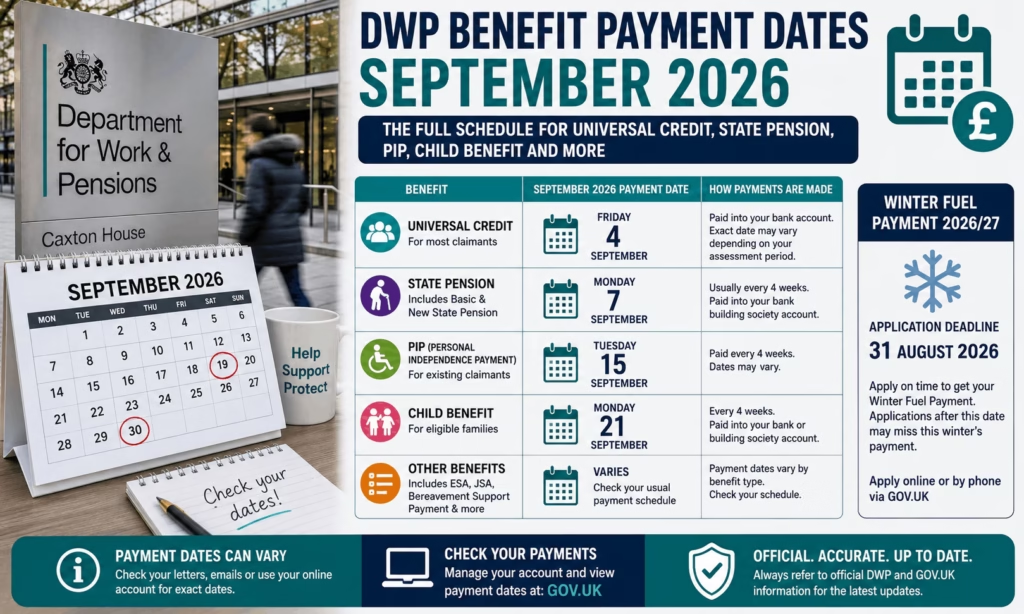
DWP Payment Dates September 2026 Key Highlights
| Benefit | How Often It Is Paid | September 2026 Note |
|---|---|---|
| Universal Credit | Monthly, based on your claim start date | No bank holiday this month, paid on your usual date |
| State Pension | Every 4 weeks, based on your National Insurance number | Paid on your usual date, no shift |
| Personal Independence Payment (PIP) | Every 4 weeks, individual award date | Paid on your usual date, no shift |
| Child Benefit | Every 4 weeks, or weekly for single parents or certain claimants | Paid on your usual date, no shift |
| Pension Credit | Every 4 weeks | Paid on your usual date, no shift |
| Employment and Support Allowance (ESA) | Usually every 2 weeks | Paid on your usual date, no shift |
| Jobseeker’s Allowance (JSA) | Usually every 2 weeks | Paid on your usual date, no shift |
| Disability Living Allowance (DLA) | Every 4 weeks | Paid on your usual date, no shift |
| Carer’s Allowance | Weekly in advance or every 4 weeks | Paid on your usual date, no shift |
| Winter Fuel Payment opt out deadline | Annual | 11:59pm, September 20, 2026 |
| Winter Fuel Payment qualifying week | Annual | September 21 to September 27, 2026 |
Because there is no bank holiday in September, this is one of the few months this year where almost nobody needs to check for an early payment. That changes again in December, when Christmas and New Year both push a wide range of payments forward.
Why Your DWP Payment Date Is Personal To You?
Unlike a single national payday, DWP and HMRC payments are personalised to each claimant rather than issued on one fixed date for everyone. Universal Credit is paid once a month, based on your assessment period, which is fixed from the date your claim started, and the money usually lands in your account around seven days after that assessment period ends. The State Pension is paid every four weeks, and which day of the week you get paid depends on the last two digits of your National Insurance number, not your birthday or when you first claimed. PIP and Disability Living Allowance both follow a four weekly cycle too, but the exact date is set individually for each claimant based on when their award started, so two people with the same condition and the same award level can still be paid on completely different days. Child Benefit is normally paid every four weeks on a Monday or Tuesday, though single parents and people receiving certain other benefits can arrange to be paid weekly instead. ESA, JSA and Income Support are typically paid fortnightly.
If your normal payment date happens to fall on a weekend or a bank holiday, the DWP rule is that you get paid on the last working day before it, with the full amount, not a reduced one. Since September 2026 has no bank holidays at all, this rule simply does not come into play this month, and every benefit listed above should follow its regular date without adjustment.
Canada Study Permit Proof of Funds Requirement Jumps to $23,448 for International Students
BC PNP Entrepreneur Immigration Draw Invites 16 Business Candidates in Latest Round
USCIS Ukraine TPS EAD Extension: Work Permits Automatically Extended Through October 19, 2026
TPS Terminations 2026: Complete Tracker for Somalia, Ethiopia, South Sudan, Syria, Haiti, and Yemen
Who Qualifies For Each Benefit?
Universal Credit is available to people on a low income or who are out of work, whether employed, self employed or unemployed, and covers renters and homeowners, single claimants, couples and families. Eligibility depends on your and your partner’s combined income, savings under £16,000, and your circumstances such as housing costs and whether you have children or a health condition.
The State Pension is not means tested. You need at least 10 qualifying National Insurance years to receive any new State Pension, and 35 qualifying years for the full amount of £241.30 a week. Anyone who reached State Pension age before April 6, 2016 instead receives the basic State Pension, worth £184.90 a week at the full rate.
PIP is available to people aged 16 up to State Pension age with a long term illness or disability that has affected their daily living or mobility for at least three months and is expected to continue for at least nine more months. It is tax free, not means tested, and does not depend on National Insurance contributions or employment status.
Pension Credit tops up the income of pensioners on a low income to a guaranteed minimum, currently £238.00 a week for a single person and £363.25 a week for a couple, and receiving Pension Credit can also unlock other help such as a free TV licence for over 75s and help with Council Tax.
Child Benefit is paid to anyone responsible for a child under 16, or under 20 if they stay in approved education or training, though households where either partner earns over £60,000 face a tapered High Income Child Benefit Charge that claws some or all of it back through the tax system.
Carer’s Allowance is available to anyone who spends at least 35 hours a week caring for someone who receives a qualifying disability benefit, provided the carer’s own earnings stay under a set weekly limit, now £204 a week, and it pays £86.45 a week from April 2026.
What Is New This September?
The Winter Fuel Payment Opt Out Deadline Falls This Month
This is the single most time sensitive DWP date in September. The Winter Fuel Payment for winter 2026 to 2027 is worth £200 or £300 depending on age and household circumstances, paid automatically to pensioners with an income of £35,000 a year or less who were born on or before June 28, 2026. The qualifying week, the specific week the DWP uses to check your circumstances, runs from September 21 to September 27, 2026. Pensioners whose income is above the £35,000 threshold still receive the payment automatically, since it is not means tested at the point of payment, but HMRC then recovers it through the tax system, either by adjusting a tax code or through Self Assessment. Anyone who would rather avoid that clawback process entirely can opt out completely by contacting the Winter Fuel Payment Centre before 11:59pm on September 20, 2026, one day before the qualifying week begins. Opting out only applies to the current winter, and anyone who changes their mind can reclaim eligibility in a future year.
Universal Credit And State Pension Both Carry Higher Rates Than Last Year
The rate increases that took effect in April 2026 are still working their way through household budgets this September. Universal Credit standard allowances rose to £338.58 a month for a single person under 25, £424.90 for a single person 25 or over, £528.34 for joint claimants both under 25, and £666.97 for joint claimants both 25 or over. The two child limit on Universal Credit was also removed from April 2026, meaning larger families now receive an extra child element for every additional child rather than being capped at two. The full new State Pension rose 4.8 percent to £241.30 a week, or £12,548 a year, under the triple lock, which compares average earnings growth, CPI inflation, and a 2.5 percent floor and pays out whichever is highest. This year earnings growth was the highest of the three measures.
PIP And Disability Benefit Rates Have Also Increased
PIP rose by 3.8 percent from April 2026, in line with the previous September’s CPI inflation figure. The daily living component now pays £76.70 a week at the standard rate and £114.60 at the enhanced rate, while the mobility component pays £30.30 at the standard rate and £80.00 at the enhanced rate. The maximum combined PIP award, enhanced daily living plus enhanced mobility, is now £194.60 a week, or £10,119.20 a year. DLA rates rose by the same percentage. Separately, the long anticipated Timms Review into the future of PIP eligibility criteria is due to report by the end of 2026, and any changes coming out of that review are not expected to take effect before a further consultation period, so no PIP claimant should expect an eligibility change this September specifically.
Full DWP Payment Calendar 2026
| Month | Bank Holiday Affecting Payments | What Changes |
|---|---|---|
| September 2026 | None | All payments land on their usual date |
| October 2026 | None in England, Wales or Northern Ireland | All payments land on their usual date |
| November 2026 | None | All payments land on their usual date |
| December 2026 | Christmas Day and Boxing Day | Payments normally due December 25 or 26 are paid earlier, on the last working day before Christmas |
Payments due around the New Year also shift, with anyone normally paid on January 1 receiving their money on December 31 instead, since New Year’s Day is a bank holiday. The DWP publishes the exact adjusted dates for the Christmas and New Year period each autumn, usually in November.
IRCC Tightens Citizenship by Descent: What the New 1,095-Day Presence Test Rules Mean for Applicants
SSI Address Change Service Enhancements: SSA’s New Fast-Track Process Explained
Social Security Payment September 2026: Five Confirmed Dates You Need to Know
How To Apply?
Universal Credit applications are made online through your Universal Credit account, and most new claims require an identity verification step and, for many claimants, a follow up interview at a Jobcentre Plus office. The State Pension is not automatically paid, you need to claim it, either online through GOV.UK, by phone, or by post, and the DWP recommends applying around four months before you reach State Pension age since it does not start automatically. PIP applications begin with a phone call to the DWP to start the claim, followed by a detailed PIP2 form describing how your condition affects you, and in most cases a face to face, phone or video assessment with an independent health professional. Pension Credit can be applied for online, by phone, or by post, and claims can be backdated by up to three months if you were eligible during that period. Child Benefit is claimed through HMRC rather than the DWP, either online or by post, and can be backdated for up to three months from the date of the claim.
Processing Time
Universal Credit’s first payment typically arrives around five weeks after your claim starts, covering a one month assessment period plus roughly seven days for the payment to process, though an advance payment can be requested to bridge that gap if needed. State Pension claims that are submitted with complete information usually process well before your State Pension age is reached, provided you apply within the recommended window. PIP is the slowest of the major DWP benefits to process, with the combined time from application to decision often running between three and five months once the assessment and any further evidence gathering is factored in. Pension Credit decisions are typically issued within a few weeks of a complete application. Child Benefit claims made online for a newborn are usually processed within around 16 weeks, though HMRC aims for faster turnaround when possible.
Official DWP And HMRC Resources
| Purpose | Official Link |
|---|---|
| Universal Credit sign in and claim status | gov.uk/sign-in-universal-credit |
| Apply for Universal Credit | gov.uk/apply-universal-credit |
| Check State Pension age and claim | gov.uk/state-pension |
| Apply for PIP | gov.uk/pip/how-to-claim |
| Pension Credit calculator and claim | gov.uk/pension-credit |
| Child Benefit claim and management | gov.uk/child-benefit |
| Winter Fuel Payment information and opt out | gov.uk/winter-fuel-payment |
| Full DWP benefit payment dates guidance | gov.uk/guidance/payments-when-your-benefit-office-is-closed |
What To Do If A Payment Does Not Arrive
Check your online Universal Credit journal or payment statement first, since it shows exactly what was calculated and when it was sent, along with any deductions such as an advance repayment or a sanction. If your payment was due on a weekend or bank holiday, remember it should already have arrived on the working day before, so check your account history rather than only the calendar date. If the DWP or HMRC has changed your payment or needs more information from you, you would normally have received a letter, text message, or a message inside your online account explaining why. If you have checked all of that and your payment genuinely has not arrived, contact the specific department responsible for your benefit directly, since Universal Credit, PIP, State Pension and Child Benefit are handled by different teams even though they all fall under the wider DWP and HMRC system.
Common Reasons A DWP Payment Gets Delayed Or Reduced
A handful of avoidable issues account for most of the delayed or unexpectedly lower DWP payments reported each month. Outdated bank details after switching accounts is the most frequent cause, and it can take several weeks for a misdirected payment to be traced and reissued. Universal Credit deductions are another common surprise, since advance payment repayments, third party deductions for rent or utility arrears, and sanctions for missed work coach appointments can all reduce the amount that actually lands compared with your headline award. For PIP and DLA claimants, a missed reassessment or a failure to return a review form on time can pause payments entirely until the review is completed, even when the underlying condition has not changed. Keeping your Universal Credit journal, PIP award letters, and bank details up to date remains the most effective way to avoid an unexpected gap in payments.
SSA Strategic Plan FY2026-2030: New Goals, Wait Times & Service Targets
SSA Ticket to Work Program: How Disability Beneficiaries Can Return to Work Without Losing Benefits
FAQs
When will my Universal Credit be paid in September 2026?
On your normal monthly payment date, since there are no bank holidays in September 2026 to cause any shift. Your exact date depends on when your assessment period started, and you can check it in your online Universal Credit journal.
What is the State Pension payment date in September 2026?
Your State Pension is paid every four weeks on a day determined by the last two digits of your National Insurance number. September 2026 has no bank holidays, so your payment lands on its usual date with no early or delayed adjustment.
When is the Winter Fuel Payment opt out deadline?
The deadline to opt out of the Winter Fuel Payment for winter 2026 to 2027 is 11:59pm on September 20, 2026. The qualifying week that determines eligibility runs from September 21 to September 27, 2026.
How much has PIP increased in 2026?
PIP rose by 3.8 percent from April 2026. The daily living component now pays £76.70 or £114.60 a week depending on the rate, and the mobility component pays £30.30 or £80.00 a week.
Is Universal Credit going up again this year?
The last increase took effect in April 2026, when standard allowances rose alongside the removal of the two child limit. The next annual uprating will apply from April 2027 and is announced closer to that date.
Do I need to reapply for the State Pension every year?
No. Once your claim is approved, the State Pension is paid automatically every four weeks for life, and only rate changes from the annual uprating affect the amount, not a fresh application.
Can I get Universal Credit and PIP at the same time?
Yes. PIP is not counted as income for Universal Credit purposes, so receiving PIP does not reduce your Universal Credit award, and in some cases it can increase it through the LCWRA element if you also have limited capability for work.
People Also Ask
How do I check my exact DWP payment date?
For Universal Credit, sign in to your online account and check your payment statement, which shows the exact date and amount. For PIP, DLA and the State Pension, the date is set individually for your award and appears in your award letter or online account rather than on a single public calendar.
Why did my benefit payment come early this month?
Payments only move earlier than their usual date when the scheduled date falls on a weekend or a bank holiday. Since September 2026 has no bank holidays, no DWP payment should arrive earlier than its normal date this month.
What happens if I miss the Winter Fuel Payment opt out deadline?
You will still receive the payment automatically if you meet the age and residency rules. If your income is above £35,000, HMRC will recover the payment later through your tax code or Self Assessment return rather than you having to pay it back separately.
Will the State Pension keep rising every year?
The triple lock guarantees the State Pension rises each year by whichever is highest of average earnings growth, CPI inflation, or 2.5 percent, so it should continue increasing annually, though the exact percentage varies depending on which measure is highest that year.
What is the difference between old style benefits and Universal Credit?
Universal Credit replaced six separate benefits, including Income Support, income based JSA, income related ESA, Housing Benefit, Child Tax Credit and Working Tax Credit, combining them into one monthly payment. Most people on the older benefits have now moved across through managed migration, though some legacy claimants, particularly certain ESA cases, are still being transitioned.
Conclusion
September 2026 is one of the calmer months on the DWP calendar, with no UK bank holidays to shift Universal Credit, State Pension, PIP, Child Benefit or any other payment away from its usual date. The date that genuinely matters this month is the Winter Fuel Payment opt out deadline, 11:59pm on September 20, 2026, just before the qualifying week begins on September 21. Alongside that, claimants are continuing to see the higher rates that took effect in April, including the 4.8 percent State Pension rise to £241.30 a week and the 3.8 percent increase applied to Universal Credit, PIP and most other DWP payments. Checking your specific payment date through your own online account, rather than relying on a single public date, remains the most reliable way to know exactly when your money will land. This article will continue to be updated monthly as the DWP and HMRC confirm new dates, rates, and policy changes.
SSDI Payment Dates September 2026: Who Gets Paid and When?
Japan Visa Renewal Fee Increase 2026: New Charges From October Explained