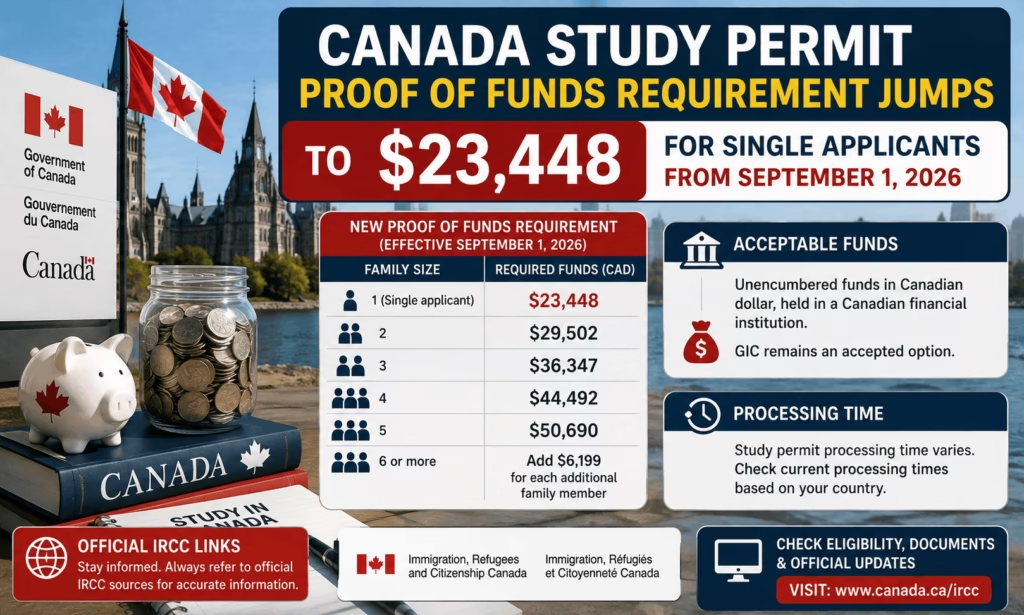
Canada Study Permit Proof of Funds Requirement: Canada has confirmed a fresh hike in the Canada study permit proof of funds requirement, and this one lands squarely on the desks of every international student planning to apply this fall. Effective September 1, 2026, a single applicant from outside Quebec will need to show at least $23,448 CAD in living-expense funds, on top of first-year tuition and return travel costs. That is $553 more than the $22,895 threshold that has applied since September 2025, a rise of roughly 2.4 percent that tracks the government’s annual cost-of-living recalculation.
The change was first flagged publicly through updated guidance pages from Canadian universities, including the University of Toronto’s Centre for International Experience and the University of Windsor’s international student office, both of which now display the $23,448 figure for applications submitted on or after September 1. Immigration, Refugees and Citizenship Canada (IRCC) has confirmed the increase is tied to 75 percent of Statistics Canada’s Low-Income Cut-Off (LICO), the same formula used to set the figure every year since the major 2024 overhaul. As of this writing, IRCC’s public proof-of-financial-support page still shows the outgoing $22,895 amount, and the department has not yet posted the full updated family-size table, so students should treat university-published figures as the most current confirmed source until the federal page catches up. We’ll be updating this article monthly as IRCC publishes its official figures.
What Changed: The New Canada Student Financial Requirement
The Canada international student financial requirement is the minimum amount of money a study permit applicant must prove they can access, without working in Canada, to cover living costs for the first year of study. It sits alongside two other mandatory categories: first-year tuition fees and return transportation costs. None of these three categories can substitute for another. A student cannot, for example, apply extra tuition savings toward the living-expense minimum.
For a single applicant applying on or after September 1, 2026, the new living-expense minimum is $23,448 CAD, up from $22,895. This is not a one-time jump. Canada has now raised this figure twice in under two years: first in January 2024, when it doubled overnight from $10,000 to $20,635, and again in September 2025 to $22,895, and now again to $23,448 for September 2026. The pattern signals that IRCC intends to keep adjusting the amount annually rather than leaving it static for a decade, as it did before 2024.
Canada Study Permit Proof of Funds Key Highlights
| Detail | Information |
|---|---|
| New requirement | $23,448 CAD (single applicant, outside Quebec) |
| Previous requirement | $22,895 CAD |
| Increase amount | $553 CAD (about 2.4%) |
| Effective date | Applications submitted on or after September 1, 2026 |
| Basis for calculation | 75% of Statistics Canada’s Low-Income Cut-Off (LICO) |
| Applies to | New study permit applications and extensions |
| Covers | Living expenses only, not tuition or travel |
| Quebec applicants | Different, separately set provincial figures apply |
| Confirmed by | University of Toronto, University of Windsor, IRCC guidance |
| Prior increases | $10,000 (pre-2024) to $20,635 (Jan 2024) to $22,895 (Sept 2025) |
BC PNP Entrepreneur Immigration Draw Invites 16 Business Candidates in Latest Round
USCIS Ukraine TPS EAD Extension: Work Permits Automatically Extended Through October 19, 2026
TPS Terminations 2026: Complete Tracker for Somalia, Ethiopia, South Sudan, Syria, Haiti, and Yemen
Why Is Canada Raising the International Student Financial Requirement Again
The short answer is inflation and the rising real cost of living in Canadian cities. The government’s own justification, repeated by IRCC since the 2024 overhaul, is that the figure must stay pegged to 75 percent of the national Low-Income Cut-Off so that students arriving in Canada are not immediately pushed into financial precarity. When the pre-2024 requirement of $10,000 was set, it had not moved in roughly two decades, and reports from student unions and food banks in Toronto and other major cities showed that many international students were arriving with funds that fell drastically short of actual rent, groceries and transit costs within their first few months.
Former Immigration Minister Marc Miller, who introduced the original 2024 increase, framed the change as protective rather than restrictive, arguing that students needed to walk in with a realistic financial cushion instead of discovering the gap only after landing. Critics, including advocacy groups such as Migrant Students United, have pushed back, arguing that repeated increases disproportionately shut out working-class applicants from countries where saving tens of thousands of Canadian dollars is simply not feasible for most families. Both sides agree on one thing: the number is now reviewed annually rather than left untouched, so applicants should expect another adjustment around September 2027.
Family Size Table: How Much You Need With Dependants
If a spouse, partner or children are accompanying the study permit holder to Canada, the required funds scale up per additional family member. Based on the confirmed per-person increment reported alongside the September 2026 update, the table below shows the new minimum living-expense amounts by household size.
| Family Size | Minimum Living-Expense Funds Required (from Sept 1, 2026) |
|---|---|
| 1 (single applicant) | $23,448 |
| 2 | $29,192 |
| 3 | $35,888 |
| 4 | $43,572 |
| 5 | $49,419 |
| 6 | $55,736 |
| 7 | $62,054 |
| Each additional member beyond 7 | Add $6,318 per person |
These figures cover living expenses only. Tuition for the primary applicant and, where applicable, travel costs for every accompanying family member are calculated and shown separately, and they are not included in the numbers above.
Quebec vs the Rest of Canada: A Different Calculation
Quebec sets its own financial requirement for international students through the Certificat d’acceptation du Québec (CAQ) process, which runs alongside the federal study permit application. Historically, Quebec’s figure has been set slightly higher than the rest-of-Canada amount. Students applying to institutions in Quebec should check the province’s own immigration portal (Immigration, Francisation et Intégration Québec) for the exact current figure rather than relying on the national $23,448 number, since the two are calculated independently and updated on different schedules.
September 2026 Refund Payments: All the Real Deposits You Could Actually Get This Month
Service Canada Benefit Payments September 2026 Dates, Amounts and Who Qualifies
Canada FMCSP Study Permit: 2,970 Spots Now Open for French-Speaking Students From 33 Countries
How to Apply: Meeting the New Proof of Funds Requirement
Meeting the higher study permit financial requirement is only half the task. The funds also have to be documented in a way that satisfies an immigration officer that the money is genuinely available, reasonably sourced, and accessible without the student needing to work illegally or rely on unverified promises. Here is how the application process works step by step.
- Confirm your total required amount. Add together first-year tuition (from your Letter of Acceptance), the living-expense minimum for your family size from the table above, and return airfare for yourself and any accompanying dependants.
- Gather your financial documents. Acceptable proof includes four months of personal bank statements, a Guaranteed Investment Certificate (GIC) from a participating Canadian financial institution, proof of a confirmed education loan, a bank draft that can be converted to Canadian currency, receipts showing tuition and housing already paid, or a letter from a sponsor accompanied by that sponsor’s own financial evidence.
- Avoid last-minute large deposits. Immigration officers are specifically trained to flag sudden, unexplained lump sums that appear shortly before an application is filed. Funds should show a consistent history across the four-month statement window.
- Submit through the IRCC portal. Apply online via your IRCC secure account, uploading your Letter of Acceptance, passport, Provincial Attestation Letter (PAL) where required, and your financial documents together in one package.
- Pay the required fees. This includes the study permit processing fee and, for most applicants, biometrics fees, both payable directly through the IRCC portal at the time of submission.
- Track your application status. Once submitted, you can log in to the same IRCC account used to apply to check real-time status updates, including biometrics requests, requests for additional documents, and final decisions.
For programs longer than one year, IRCC does not require proof of funds for every remaining year up front. Instead, applicants must show they have a credible plan for the following years, such as evidence of ongoing parental income, a multi-year scholarship letter, or a structured education loan disbursement schedule.
Processing Time: How Long Will Your Application Take
Study permit processing times vary by country of application and by season, with the run-up to the September intake historically being one of the busiest periods of the year. As a general pattern, applicants submitting complete, well-documented files with clear proof of funds tend to move through initial review faster than files that trigger a request for supplementary financial documents. Because insufficient or poorly documented funds is consistently cited by IRCC as one of the leading causes of processing delays and refusals, getting the new $23,448 threshold correctly documented from the outset is one of the most effective ways to avoid extended processing. Applicants should check the live, country-specific processing time estimator on the official IRCC website before submitting, since published estimates are updated regularly and differ significantly by visa office.
GIC Payment Schedule: How Funds Are Released After Arrival
For students who choose a Guaranteed Investment Certificate as their proof of funds, it is important to understand the payment schedule, since a GIC is not handed over as one lump sum on arrival. Under the standard structure offered by participating Canadian banks, a portion of the total GIC amount, typically around 10 to 15 percent, is released to the student shortly after they land and open their Canadian bank account. The remaining balance is then disbursed in equal monthly instalments over the following months, effectively spreading the full living-expense amount across the year it is meant to cover. This monthly payment schedule is designed to prevent students from spending their entire cushion in the first few weeks and mirrors the same logic behind the LICO-based calculation itself: the money should last the full year, not just the first semester.
Common Mistakes Applicants Make With Proof of Funds
Several recurring errors show up in refused or delayed applications, and most of them are avoidable with careful preparation.
- Treating the living-expense figure alone as the total requirement, and forgetting to add tuition and travel costs on top of it.
- Relying on a single large deposit made shortly before applying, without a paper trail explaining where the money came from.
- Submitting a sponsor letter with no accompanying evidence of the sponsor’s own income or bank history.
- Using outdated pre-September 2025 figures, which now fall more than $2,000 short of the current single-applicant minimum.
- Applying Quebec’s financial figures to a non-Quebec institution, or the reverse.
- Failing to explain how tuition and living costs will be covered in year two and beyond for multi-year programs.
IRCC Tightens Citizenship by Descent: What the New 1,095-Day Presence Test Rules Mean for Applicants
SSI Address Change Service Enhancements: SSA’s New Fast-Track Process Explained
Social Security Payment September 2026: Five Confirmed Dates You Need to Know
Official Resources and Useful Links
| Resource | Purpose | Official Link |
|---|---|---|
| IRCC Proof of Financial Support | Full official requirements and documents list | canada.ca/en/immigration-refugees-citizenship/services/study-canada/study-permit/get-documents/financial-support.html |
| IRCC Secure Account (Apply/Login) | Create an account, apply, and manage your application | canada.ca/en/immigration-refugees-citizenship/services/application/account.html |
| Check Application Status | Track processing status and biometrics requests | canada.ca/en/immigration-refugees-citizenship/services/application/check-status.html |
| IRCC Processing Times Tool | Country-specific estimated processing times | canada.ca/en/immigration-refugees-citizenship/services/application/check-processing-times.html |
| Provincial Attestation Letter (PAL) Info | Check if your application requires a PAL | canada.ca/en/immigration-refugees-citizenship/services/study-canada/study-permit/prepare/provincial-attestation-letter.html |
| Quebec CAQ Requirements | Separate financial requirement for Quebec institutions | quebec.ca/en/education/going-to-quebec-school/study-permit/certificat-acceptation-quebec |
FAQs About Canada Study Permit Proof of Funds
What is the new proof of funds amount for Canada study permits in 2026?
Starting September 1, 2026, a single applicant applying from outside Quebec must show at least $23,448 CAD in living-expense funds, in addition to first-year tuition and return travel costs.
Does the $23,448 figure include tuition fees?
No. The $23,448 amount covers living expenses only. Tuition for your first year and return transportation costs must be demonstrated separately, on top of this amount.
How much more do I need to show compared to the current requirement?
You need $553 more than the outgoing $22,895 threshold that applied to applications submitted between September 2025 and August 31, 2026.
Is a Guaranteed Investment Certificate still accepted as proof of funds?
Yes. A GIC from a participating Canadian financial institution remains one of the most widely accepted forms of proof, even though the dedicated Student Direct Stream that once required it has been discontinued.
Does this new amount apply to Quebec-bound students?
No. Quebec sets its own financial requirement through the Certificat d’acceptation du Québec process, separate from the federal figure discussed here.
What happens if my application was submitted before September 1, 2026?
Applications submitted before the effective date are generally assessed against the financial requirement in force at the time of submission, not the new amount.
Can I combine multiple sources of funds to meet the requirement?
Yes. You can combine sources such as personal savings, a GIC, an education loan, and sponsor support, but each individual source must be independently documented and credible.
How much do I need if I’m bringing my spouse and one child?
For a family of three, including the applicant, the new minimum living-expense requirement is $35,888, in addition to tuition and travel costs for all three family members.
Why does Canada keep raising this requirement every year?
IRCC ties the figure to 75 percent of Statistics Canada’s Low-Income Cut-Off, which is recalculated periodically to reflect the actual cost of living, so the requirement is adjusted rather than left fixed for long stretches.
Where can I check the official, most current figure before applying?
Always confirm the live figure on IRCC’s official proof of financial support page on canada.ca before submitting your application, since amounts are subject to revision.
Conclusion
The jump to a $23,448 Canada study permit proof of funds requirement is a modest increase in percentage terms, just 2.4 percent, but it adds another real financial hurdle for international students already budgeting for tuition, travel, insurance and settling-in costs. Because IRCC has now adjusted this figure three times since 2024, the safest approach for any applicant is to stop relying on numbers seen in older forum posts or outdated blog articles and instead verify the exact current amount, family-size table and accepted documents directly on IRCC’s official website before filing. Students applying on or after September 1, 2026, should build their financial documentation around the $23,448 single-applicant baseline, or the corresponding family-size figure, well before their intended submission date to avoid delays tied to insufficient or poorly explained funds. We’ll be updating this article monthly as IRCC releases its complete, formally published figures.
SSA Strategic Plan FY2026-2030: New Goals, Wait Times & Service Targets
SSA Ticket to Work Program: How Disability Beneficiaries Can Return to Work Without Losing Benefits
SSDI Payment Dates September 2026: Who Gets Paid and When?
Japan Visa Renewal Fee Increase 2026: New Charges From October Explained