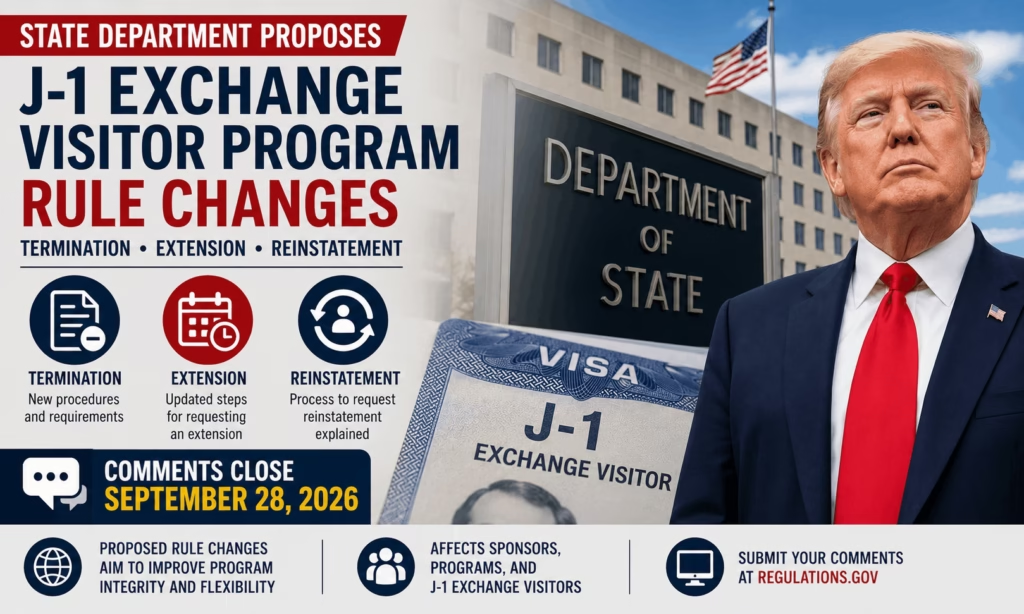
J-1 Exchange Visitor Program: The US Department of State has opened a 60-day public comment window on a sweeping rewrite of how the J-1 Exchange Visitor Program handles terminations, program extensions and reinstatement, and anyone connected to a J-1 program, whether a sponsor organization, a university international office, an au pair agency or an exchange visitor themselves, has until September 28, 2026 to weigh in before the rule can be finalized. Published on July 30, 2026 by the Bureau of Educational and Cultural Affairs, the proposed rule is the first major overhaul of this section of the regulations since 1999, and it arrives at a moment when the entire framework for nonimmigrant students and exchange visitors is already being reshaped by a separate Department of Homeland Security rule ending duration of status for F, J and I categories.
At its core, the proposal rewrites 22 CFR Part 62 to give the State Department clearer, broader authority to terminate a J-1 participant’s program in specific circumstances, while also simplifying how sponsors correct SEVIS record errors and how exchange visitors apply for reinstatement after falling out of status. The rule adds falsification of information as a mandatory ground for program termination, folds today’s separate categories of minor infractions and substantive violations into a single track, and replaces the current tiered reinstatement system with one 30-day self-correction window that sponsors can use directly in SEVIS without filing anything with the State Department. We’ll be updating this article monthly as the comment period progresses and as the Department of State moves toward a final rule.
J-1 Exchange Visitor Program Key Highlights
| Detail | Information |
|---|---|
| Rule name | Exchange Visitor Program, Termination of Program Participation, Extension of Program and Reinstatement to Valid Program Status |
| Issuing agency | US Department of State, Bureau of Educational and Cultural Affairs |
| Published | July 30, 2026 |
| Comment deadline | September 28, 2026 |
| Docket ID | DOS-2026-0859 |
| Regulatory ID Number | RIN 1400-AF23 |
| Last major update to this section | 1999 |
| Related rule | DHS fixed admission period rule for F, J, I nonimmigrants, effective September 15, 2026 |
| Affected groups | J-1 sponsors, exchange visitors, au pair agencies, universities, research institutions |
| Current status | Proposed rule, not yet in effect |
Latest Update On The J-1 Exchange Visitor Program Rule
As of this month, the proposed rule is officially open for public comment under Docket ID DOS-2026-0859 and Regulatory Identification Number RIN 1400-AF23. The 60-day comment window that opened on July 30, 2026 runs through September 28, 2026, giving universities, exchange sponsors, au pair agencies, employers and current J-1 or J-2 visa holders a formal opportunity to submit feedback before the Department finalizes the regulation. Comments can be filed electronically through regulations.gov by searching the docket number, or emailed directly to the Department’s Office of Private Sector Exchange with RIN 1400-AF23 included in the subject line.
Immigration attorneys tracking the proposal note that it is deliberately timed to align with the Department of Homeland Security’s separate rule eliminating duration of status for F-1, J-1 and I nonimmigrants, which takes effect September 15, 2026 and caps most J-1 authorized stays at four years tied to the program dates listed on Form DS-2019. Because that companion rule creates a fixed admission period for exchange visitors for the first time, the State Department says its termination and reinstatement framework needs updating so that SEVIS recordkeeping, sponsor obligations and compliance enforcement stay consistent across both agencies.
ICE Detained Military Families: AP Finds 50+ Spouses and Parents Held
What Is The J-1 Exchange Visitor Program
The J-1 Exchange Visitor Program traces back to the Mutual Educational and Cultural Exchange Act of 1961, commonly known as the Fulbright-Hays Act, and is run by the State Department’s Bureau of Educational and Cultural Affairs. It allows foreign nationals to come to the United States on a temporary basis to participate in academic study, research, teaching, training or cultural exchange under the sponsorship of a designated program sponsor, which can be a university, research institute, government agency or private organization approved to issue Form DS-2019. Categories under the program include college and university students, research scholars, professors, interns, trainees, teachers, camp counselors and au pairs, each with its own program length limits and rules.
Sponsors are responsible for monitoring participants through the Student and Exchange Visitor Information System, the same SEVIS database used for F-1 students, and for reporting changes in status, program completion, or violations to the State Department. When an exchange visitor falls out of compliance, whether through unauthorized work, failure to maintain health insurance, or simply staying beyond their program end date, the current regulations sort the problem into minor or technical infractions that a sponsor can fix directly, substantive violations that require a formal reinstatement application to the State Department, and non-reinstatable violations that end a person’s ability to continue in the program altogether.
What The Proposed Rule Actually Changes
The proposed rule touches three separate areas of the regulations that have not been substantially rewritten since 1999, and each change affects a different part of the J-1 lifecycle.
Termination authority is being expanded. Under the proposal, unauthorized employment and falsification of information become explicit, mandatory grounds for terminating a J-1 program, rather than issues a sponsor is simply expected to detect and manage. The rule also gives the State Department discretionary authority to terminate a program directly in limited circumstances, including when a participant’s visa has been revoked, a power the Department currently exercises only in narrow situations.
Reinstatement procedures are being simplified. Instead of the current three-tier system that separates minor or technical infractions, substantive violations and non-reinstatable violations, the proposal collapses the first two tiers into one track. Sponsors would get a 30-day window from the date a SEVIS record falls out of status to use a new Correct SEVIS Status action and restore the record to Active or Inactive, without submitting a formal application to the State Department and without paying a reinstatement fee. Attorneys reviewing the draft describe this as a double-edged change, since it gives sponsors a faster, cheaper way to fix an honest mistake, but it also shortens the amount of time available before a case moves into the more expensive, more formal reinstatement process.
Extension of program rules are being tightened. The proposal sets a firm three-month deadline for extension requests that go beyond a category’s maximum program duration, closing a gap in the current rule where timelines were less clearly defined. It also rescinds the separate extension-of-program provision that currently applies only to au pairs, folding that category into the same general extension framework used for other exchange visitor categories.
New definitions are being added. The rule proposes formal regulatory definitions for Unauthorized Employment and Valid Program Status, terms that are used throughout the existing regulations but have never been precisely defined in the text itself, a gap that has reportedly led to inconsistent interpretation by different sponsors and different State Department reviewers over the years.
Why This Rule Is Being Proposed Now
The State Department has framed the proposal as an effort to modernize a regulatory framework that predates modern SEVIS functionality by more than two decades. When the current reinstatement rules were written in 1999, sponsors managed exchange visitor records largely on paper, and the tiered system of infractions reflected the manual processes of that era. Since then, SEVIS has become a fully electronic tracking system capable of flagging status changes automatically, and the Department argues the regulations should reflect that shift by letting sponsors self-correct records digitally rather than routing every minor issue through a formal paper-based application.
The timing also lines up closely with the broader overhaul of nonimmigrant student and exchange visitor rules happening across the federal government in 2026. With the Department of Homeland Security ending duration of status and introducing fixed admission periods for F, J and I categories on September 15, 2026, exchange visitors will for the first time have a specific admit-until date rather than an open-ended status tied to continued program participation. The State Department says its termination and reinstatement framework needs to be updated in parallel so that a J-1 participant who falls out of status under the new fixed-period system has clear, modern pathways to fix the problem rather than relying on rules designed for the old duration-of-status framework.
2027 HSA Contribution Limits Announced: IRS Confirms $4,500 and $9,000 Caps
FTC Refund 2026: Millions of Americans May Be Owed Money and Most Don’t Know It
What This Means For Sponsors And Exchange Visitors
For program sponsors, the proposed rule offers a mix of relief and added responsibility. The new 30-day self-correction window through SEVIS removes the cost and paperwork burden of filing a formal application for straightforward errors, but sponsors will need tighter internal monitoring to catch status problems within that shortened window, since missing it pushes a case into the more demanding formal reinstatement track. Au pair agencies in particular should review the proposal closely, since the rule eliminates their separate extension timeline and folds au pair extensions into the general rule used by other exchange categories.
For individual exchange visitors, the expanded, more clearly defined grounds for termination mean that unauthorized employment and falsified information carry sharper, more automatic consequences than under the current framework, where sponsors had more discretion in how they characterized a violation. Anyone currently on a J-1 or J-2 visa, or planning to apply for one, should pay close attention to how their sponsor communicates about SEVIS status, since the shortened correction window puts more pressure on both sponsors and participants to resolve paperwork issues quickly once a record falls out of Active status.
How To Submit A Comment
Members of the public, immigration attorneys, universities, exchange sponsors and affected individuals can formally weigh in on the proposed rule before the September 28, 2026 deadline. Comments submitted through regulations.gov become part of the official rulemaking record and are considered by the Department of State before it drafts a final rule, which is the same process used across federal agencies under the Administrative Procedure Act.
Direct Express Card Transition to Fifth Third Bank: What 3.6 Million Cardholders Need to Know
Federal Fuel Excise Tax Suspension: Ford Pushes Carney to Extend Relief Past Labour Day
USCIS Restored Power To Deny Without RFE: Here Is What Policy Alert PA-2026-05 Actually Changes
IEEPA Tariff Refund Process: How Businesses Are Claiming Their Share of $166 Billion
Official Sources
| Resource | Link |
|---|---|
| Submit a comment on the proposed rule | regulations.gov, search Docket ID DOS-2026-0859 |
| Department of State, Bureau of Educational and Cultural Affairs | exchanges.state.gov |
| J-1 Exchange Visitor Program overview | j1visa.state.gov |
| Comment by email | JExchanges@state.gov, include RIN 1400-AF23 in subject line |
| SEVIS information for sponsors | ice.gov/sevis |
| DHS fixed admission period rule for F, J, I nonimmigrants | federalregister.gov |
FAQs
What is the deadline to comment on the new J-1 Exchange Visitor Program rule?
The public comment period closes on September 28, 2026, exactly 60 days after the rule was published on July 30, 2026.
Is the J-1 Exchange Visitor Program rule already in effect?
No. It is a proposed rule open for public comment. It only becomes binding after the Department of State reviews the comments and publishes a final rule.
What are the biggest changes in the proposed rule?
The rule adds falsification of information and unauthorized employment as mandatory termination grounds, combines two categories of violations into one reinstatement track with a 30-day SEVIS self-correction window, sets a three-month deadline on certain extension requests, and removes the separate extension timeline for au pairs.
Does this rule affect F-1 students too?
No. This specific proposal applies to the J-1 Exchange Visitor Program under 22 CFR Part 62. It is separate from, but designed to align with, the Department of Homeland Security rule ending duration of status for F, J and I nonimmigrants that takes effect September 15, 2026.
How do I submit a comment on this rule?
Comments can be filed online at regulations.gov under Docket ID DOS-2026-0859, or emailed to JExchanges@state.gov with RIN 1400-AF23 in the subject line.
Will au pairs be affected by this rule?
Yes. The proposal rescinds the separate extension-of-program provision that currently applies only to au pairs and places that category under the same general extension rules used for other J-1 categories.
What happens if a J-1 participant falls out of status under the new rule?
Sponsors would have a 30-day window to self-correct the SEVIS record through a new Correct SEVIS Status action before the case moves into the more formal, and more difficult, reinstatement process.
Who administers the J-1 Exchange Visitor Program?
The US Department of State’s Bureau of Educational and Cultural Affairs administers the program, while the Department of Homeland Security oversees the SEVIS database used to track participants.
Can a J-1 visa be terminated without notice under the proposed rule?
The proposed rule gives the State Department discretionary authority to terminate a program in limited circumstances, such as a visa revocation, in addition to the existing mandatory grounds like unauthorized employment.
What is the difference between reinstatement and termination for J-1 status?
Reinstatement is the process of restoring valid program status after a violation or lapse, while termination ends a participant’s ability to continue in the exchange visitor program altogether.
Conclusion
The State Department’s proposed overhaul of J-1 Exchange Visitor Program termination, extension and reinstatement rules represents the most significant rewrite of this section of federal regulations in more than 25 years, and it is arriving at the same time the entire framework for nonimmigrant students and exchange visitors is shifting under a separate Department of Homeland Security rule. With the comment period running through September 28, 2026, sponsors, universities, au pair agencies and exchange visitors still have a limited window to formally raise concerns before the rule is finalized. Anyone affected by the J-1 program should review the proposal closely and consider submitting comments, since the changes to reinstatement timelines and termination grounds will directly reshape how compliance issues are handled once the rule takes effect.
50% US Tariffs on Canadian Goods: Full List and What Changes
Maryland SNAP Cost-Sharing Rules: Why the State Faces a $300 Million Bill Starting 2027
Borrower Defense Student Loans: How to Apply for a Full Discharge?