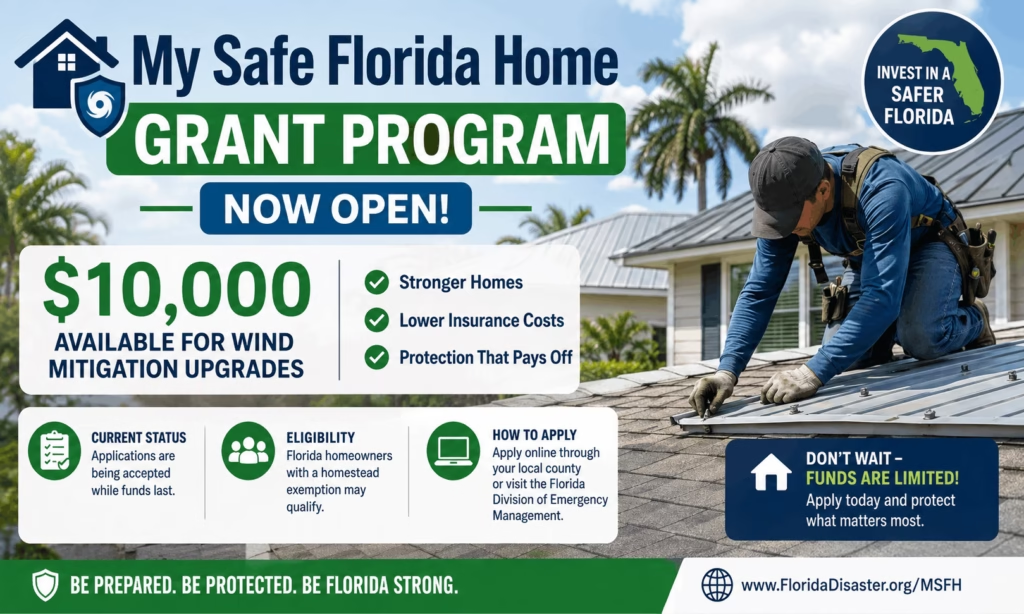
My Safe Florida Home Grant Program 2026: The My Safe Florida Home grant program is open right now, and the state’s own portal confirms both free wind mitigation inspections and grants of up to $10,000 remain available to eligible homeowners as of this week. That is a meaningful update for anyone who has been watching this program closely, since it has a well-documented history of running out of money within days or weeks of reopening. This time, Florida lawmakers backed the program with a Memorial Day 2026 budget deal that reappropriated more than $405 million toward My Safe Florida Home and its condo counterpart, specifically targeting a backlog of roughly 45,000 homeowners who completed inspections in earlier cycles but never received a grant award. We’ll be updating this article monthly as new funding figures, priority group updates, and application deadlines come out of Tallahassee.
For Florida homeowners who have not yet applied, the program still works the same way it has since being revived in 2022: a free professional inspection identifies specific hurricane-hardening upgrades your home needs, and if you qualify, the state helps pay for those upgrades, up to $10,000. The current 2025-2026 funding cycle reopened on August 4, 2025 with $352 million, and this year’s eligibility is narrower than in past cycles, limited specifically to low- and moderate-income homeowners under the rules passed in HB 811. If your household falls above that threshold, or if you already went through an inspection last year without ever getting a grant, the details below explain exactly where things stand and what to do next.
My Safe Florida Home Grant Program Status – Latest Update
As of this month, the official My Safe Florida Home Program portal lists both the free wind mitigation inspection and the $10,000 grant application as actively available, a status confirmed directly on mysafeflhome.com. This follows the Florida Legislature’s approval of a $115 billion state budget over Memorial Day weekend 2026, which carried forward more than $405 million in previously unspent funds across My Safe Florida Home and the newer My Safe Florida Condo Pilot Program. Officials say the reappropriated money is aimed squarely at clearing the backlog of homeowners who completed a wind mitigation inspection but were left waiting when earlier funding ran dry. The same budget package also included a separate three-year sales tax exemption on impact windows and doors, which lowers the out-of-pocket cost of hurricane-hardening projects regardless of whether a homeowner is going through the grant program or paying independently.
Key Highlights: My Safe Florida Home Grant Program 2026
| Detail | Current Status |
|---|---|
| Program name | My Safe Florida Home (MSFH) Program |
| Administered by | Florida Department of Financial Services |
| Statutory authority | Florida Statute Section 215.5586 |
| Maximum grant amount | $10,000 per home |
| Current cycle funding | $352 million (2025-2026), reopened Aug. 4, 2025 |
| Latest reappropriation | Over $405 million (MSFH + Condo Pilot combined), approved Memorial Day 2026 |
| Current eligibility | Low- and moderate-income homeowners only |
| Backlog being addressed | Approximately 45,000 homeowners with completed inspections, no grant yet |
| Inspections conducted since 2022 | Over 106,000 |
| Grants approved since 2022 | Over 38,500 |
| Total appropriated since 2022 revival | Nearly $634 million |
| Reported average insurance savings | About $1,014 per year for grant recipients |
| Portal | mysafeflhome.com |
What Is the My Safe Florida Home Program?
The My Safe Florida Home program was originally created in 2006, sat dormant for over a decade, and was revived in 2022 as part of a package of insurance reforms responding to Florida’s property insurance crisis. It has two connected parts. First, an eligible homeowner receives a free wind mitigation inspection from a state-authorized inspector, who documents the home’s existing storm protection and identifies specific upgrades that would strengthen it further. Second, based on that inspection report, the homeowner can apply for a grant to help fund those recommended improvements, with the state contributing up to $10,000 toward eligible projects such as roof-to-wall reinforcements, roof deck attachment upgrades, secondary water resistance for the roof, and impact-rated windows, doors, and garage doors.
The inspection alone carries value even for homeowners who never pursue a grant, since the report can be submitted to an insurance carrier to confirm any wind-mitigation discounts the home already qualifies for under Florida law.
Colorado TABOR Refund and PTC Rebate 2026: Who Qualifies and How Much You Can Get
USCIS E-Filing Mandate: New DHS Rule Gives Agency Power To Retire Paper Immigration Forms
Denaturalization Cases Surge As DOJ Files Record 25 Complaints In Just Two Weeks
Who Qualifies for the Program This Cycle
Eligibility for the My Safe Florida Home grant program has tightened compared to earlier years. For the current 2025-2026 cycle, only low-income and moderate-income homeowners can apply for grant funding, a change enacted under House Bill 811. Higher-income homeowners were excluded from this cycle entirely, though they may still be able to access a free inspection depending on remaining inspection funding.
A home generally must meet these conditions to qualify:
- Single-family, detached, site-built residence, including qualifying townhouses
- Primary, homesteaded residence, not a rental, vacation home, or second home
- Building permit for original construction issued before January 1, 2008
- Insured value of $700,000 or less for the matching grant tier, though low-income applicants are exempt from this cap
- Not a condominium, mobile home, manufactured home, or multi-family dwelling
Income eligibility is measured against your county’s Area Median Income:
- Low-income: household income at or below 80 percent of your county’s median income
- Moderate-income: household income above 80 percent but at or below 120 percent of your county’s median income
How Much Money You Can Actually Get
Grant amounts depend on your income category and how much you spend on qualifying improvements.
| Income Category | Grant Structure | Maximum Grant |
|---|---|---|
| Low-income (at or below 80% of county AMI) | No matching funds required | Up to $10,000 |
| Moderate-income (80% to 120% of county AMI) | State matches $2 for every $1 spent | Up to $10,000 |
For moderate-income homeowners, a project needs to cost around $15,000 out of pocket to unlock the full $10,000 state match. Homeowners who spend less still receive a proportional match. Because grants are issued on a reimbursement basis, homeowners generally must pay their contractor in full first and then submit a completed draw request with proof of payment before receiving state funds, unless they qualify under the low-income tier, which does not require this upfront documentation.
Application Priority Groups
Instead of a single first-come, first-served opening, the My Safe Florida Home program now releases applications in staggered priority groups based on age and income, so that the homeowners considered most vulnerable get access first. For the 2025-2026 cycle, the groups opened in this order:
| Group | Description | Window Opened |
|---|---|---|
| Group 1 | Low-income homeowners age 60 and older | August 4, 2025 |
| Group 2 | Low-income homeowners under age 60 | August 18, 2025 |
| Group 3 | Moderate-income homeowners age 60 and older | September 1, 2025 |
| Group 4 | Moderate-income homeowners under age 60 | September 15, 2025 |
| Group 5 | All other eligible homeowners (higher-income) | Excluded this cycle |
All four active windows have now cycled through, and new applications entering the system are sorted into their appropriate priority group and processed against remaining funds on a first-come, first-served basis within that group.
How to Appl for My Safe Florida Home Grant Program 2026?
The application runs entirely through the official participant portal and follows a defined sequence:
- Create an account on the secure Participant Portal linked from mysafeflhome.com
- Complete the Prioritization Questionnaire, which determines your income and age category
- Wait to be placed into an Inspection Group; placements are updated several times each week
- Complete the Inspection Application once your group is activated
- Undergo the free wind mitigation inspection with an assigned, state-authorized inspector
- Review your Inspection Report, which lists recommended improvements and your potential grant eligibility
- Submit a Grant Application if your home qualifies, selecting a licensed Florida contractor to perform the work
Homeowners who already completed an inspection in a previous cycle but never received a grant do not need to start over. In most cases, that inspection remains valid, and the homeowner simply needs to log back into the portal, confirm their prioritization questionnaire is current, and proceed directly to the grant application stage once their group is reactivated.
Official Links: Login, Registration, and Status Check
| Purpose | Official Resource |
|---|---|
| Create an account / apply | mysafeflhome.com/create-account |
| Sign in to an existing account | mysafeflhome.com/sign-in |
| Check eligibility for inspections | mysafeflhome.com eligibility quiz |
| Check eligibility for $10,000 grant | mysafeflhome.com grant eligibility quiz |
| Program FAQs and support | mysafeflhome.com/portal-support |
| Approved contractor information | mysafeflhome.com/contractor-micro |
| Florida Department of Financial Services program page | myfloridacfo.com/mysafeflhome |
| Condo Pilot Program (separate application) | mysafeflcondo.com |
| Program phone line | 850-427-2559 |
What the Grant Covers?
Approved improvements under the My Safe Florida Home program generally fall into two categories: roof and structural upgrades, and opening protection. Roof-related improvements include strengthening the roof-to-deck attachment, reinforcing roof-to-wall connections, and installing secondary water resistance barriers. Opening protection covers upgrading windows, exterior doors, and garage doors to impact-rated products, along with adding storm shutters where applicable. Homeowners are required to use a Florida-licensed contractor for any funded work, and the program recommends obtaining bids from at least three contractors before choosing one.
Why This Program Keeps Running Out of Money?
The My Safe Florida Home grant program has a consistent pattern since its 2022 revival: demand has outpaced whatever the Legislature appropriates almost every single year. In 2024, a $200 million infusion was exhausted within roughly two weeks of the portal reopening, leaving thousands of homeowners who had already completed inspections stuck waiting for grant funding that never arrived before the fiscal year closed. That waiting list grew to an estimated 45,000 households, which is precisely the group the Memorial Day 2026 budget reappropriation was designed to address. Governor Ron DeSantis had requested significantly more funding in recent budget cycles than the Legislature ultimately approved, reflecting how popular, and how consistently underfunded relative to demand, this program has been.
Chapter 33 VA Benefits Housing Allowance: How Much Can You Get Per Month
State Farm Dividend: Who Qualifies to Receive Part of the $5 Billion Payout
H-1B Visa Ban Texas Schools: Abbott Wants Exactly Zero Foreign Workers, What Indians Should Know
Trump Halts 50 Percent Tariffs Canada: What the Last Minute Deal With Ottawa Means
Green Card Rule Changes: New Public Charge Test to Assess Age, Health, Family Status and Finances
Insurance Savings Tied to the Program
Beyond the direct grant money, the program’s core selling point is long-term savings on home insurance premiums. Florida law requires insurers to offer discounts for documented wind mitigation features, and homeowners who completed the free inspection, made improvements, and reported their new discounts back to insurers have reported average annual savings of roughly $1,014, based on figures compiled by the News Service of Florida. Even homeowners who do not ultimately receive grant funding can use their free inspection report to confirm they are receiving every wind-mitigation discount their home currently qualifies for.
Common Mistakes That Disqualify Applicants
A few recurring errors show up often enough that they are worth flagging directly:
- Starting construction before receiving official grant approval, which automatically disqualifies the project from reimbursement, regardless of documentation
- Applying with a private, outside wind mitigation inspection instead of the program’s own state-authorized inspector, since private inspections are not accepted for MSFH purposes
- Leaving the age and income prioritization questionnaire incomplete after a previous inspection, which can leave an otherwise-qualified applicant stuck outside the active priority groups
- Applying for a property that does not meet the single-family, site-built, pre-2008 construction requirement, which is a hard eligibility line rather than a preference
- Choosing an unlicensed or unregistered contractor, since only work performed by a Florida-licensed contractor qualifies for reimbursement
Official Sources
| Source | Link |
|---|---|
| My Safe Florida Home Official Portal | mysafeflhome.com |
| Florida Department of Financial Services Program Page | myfloridacfo.com/mysafeflhome |
| Florida Statute 215.5586 (Program Authority) | leg.state.fl.us |
| My Safe Florida Condo Pilot Program | mysafeflcondo.com |
| Florida Legislature Budget Documents | myfloridahouse.gov |
FAQs
Is the My Safe Florida Home grant program still accepting applications?
Yes, as of this update the official portal lists both free wind mitigation inspections and the $10,000 grant application as currently available, though eligibility is limited to low- and moderate-income homeowners for the current cycle.
How much money can I get from the My Safe Florida Home program?
Eligible homeowners can receive up to $10,000. Low-income applicants can receive the full amount without matching funds, while moderate-income applicants receive a $2-for-$1 state match on what they spend, up to the $10,000 cap.
Who is eligible for the My Safe Florida Home grant?
You must own a single-family, site-built, homesteaded residence with a building permit issued before January 1, 2008, and your household income must fall at or below 120 percent of your county’s median income for this funding cycle.
Can renters or condo owners apply for this program?
No, the standard My Safe Florida Home program does not cover rentals, vacation homes, mobile homes, or condominiums. Condo associations have a separate program called the My Safe Florida Condo Pilot.
I had an inspection last year but never got a grant. Do I need to start over?
No, in most cases your existing inspection remains valid. Log back into your account, confirm your prioritization questionnaire is up to date, and proceed to the grant application once your priority group is active.
How do I apply for the My Safe Florida Home grant program?
Create an account at mysafeflhome.com, complete the prioritization questionnaire, wait for placement into an inspection group, complete the free inspection, and then submit a grant application if your home qualifies.
Does the grant pay for the work upfront or after completion?
Grants are reimbursement-based for moderate-income homeowners, meaning you generally pay your contractor first and submit a paid invoice for reimbursement. Low-income homeowners are exempt from this upfront payment requirement.
What home improvements does the grant cover?
Covered improvements include roof-to-wall and roof-deck attachment reinforcement, secondary water resistance for roofs, impact-rated windows and doors, and reinforced garage doors.
How long does it take to receive grant funds after applying?
Timelines vary by application volume and funding availability, but many homeowners with a complete, error-free submission report receiving reimbursement within roughly six to ten weeks of final inspection.
Will the My Safe Florida Home program run out of money again?
It has run out of funding in most prior cycles, sometimes within weeks of reopening. The program relies on annual legislative appropriations with no guaranteed funding level, so applying as early as your priority group allows remains the safest approach.
People Also Ask
What is the maximum home value allowed for the My Safe Florida Home grant? Homes must generally be insured for $700,000 or less to qualify for the standard matching grant, though low-income applicants are exempt from this insured-value requirement.
Does My Safe Florida Home actually lower insurance premiums? Homeowners who completed improvements and reported their new wind-mitigation discounts to insurers have reported average savings of about $1,014 per year, according to figures compiled by the News Service of Florida.
Is My Safe Florida Home a loan I have to pay back? No, it is a grant, not a loan. Homeowners are not required to repay funds received through the program as long as the work was completed and documented according to program rules.
How is the My Safe Florida Home program funded? The program is funded through annual appropriations from the Florida Legislature’s general revenue budget, which is why available funding and eligibility rules can change from one fiscal year to the next.
How My Safe Florida Home Compares to Other State Programs
Florida is not alone in offering hurricane or disaster-hardening assistance, but the structure of My Safe Florida Home is fairly distinctive. Louisiana and Alabama both run smaller-scale wind mitigation grant or fortified-roof programs, though neither has matched Florida’s combined scale of free inspections plus a $10,000 direct grant available to individual homeowners. South Carolina’s Safe Home program offers a comparable model with grants up to $5,000, roughly half of Florida’s maximum. What sets My Safe Florida Home apart is the direct link between the inspection, the grant, and a guaranteed statutory insurance discount for documented wind mitigation features, which most comparable state programs do not combine into a single pipeline.
Conclusion
The My Safe Florida Home grant program remains one of the most direct ways Florida homeowners can offset the rising cost of hurricane preparation and property insurance, and its current status, both free inspections and $10,000 grants actively available, marks one of the stronger funding positions the program has been in for several cycles. With more than $405 million in reappropriated money aimed squarely at clearing a 45,000-household backlog, this is a meaningful window for anyone who applied in the past without success, as well as new low- and moderate-income applicants who have not yet started the process. Given the program’s well-documented history of exhausting its funding quickly, homeowners who are eligible under the current priority groups should complete their prioritization questionnaire and move through the application steps as soon as possible rather than waiting for a future cycle that may come with a smaller budget or narrower eligibility.
Employment Insurance (EI) 2026 Rule Changes: What Every Canadian Worker Needs to Know
Empire State Child Credit 2026: $1,000 Per Child Under 4, Full Eligibility & Payment Guide
Oregon Kicker Tax Credit 2026: How To Claim Your Share Of The $1.41 Billion Surplus
California Climate Credit 2026: Payment Timing Just Changed, Here Is What to Expect on Your Bill