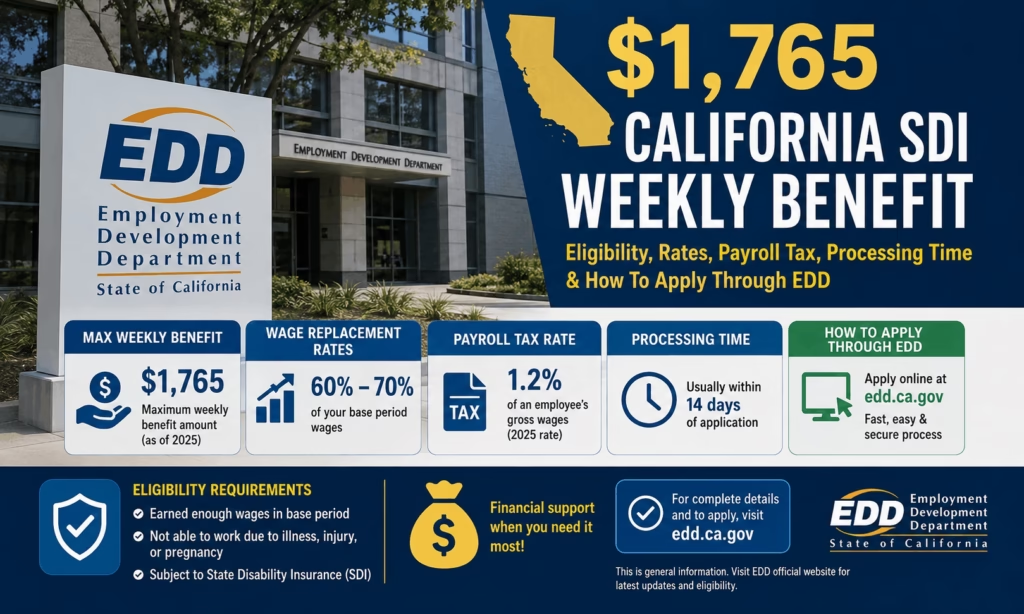
$1765 California SDI Weekly Benefit: California workers who can’t work due to a non-work illness, injury, or pregnancy can now collect up to $1,765 a week through State Disability Insurance, after the Employment Development Department confirmed the 2026 benefit increase tied to the state’s rising average wage. The new maximum, up from $1,681 in 2025, applies to any SDI claim with a start date on or after January 1, 2026, and it arrives alongside a payroll tax that continues to apply to every dollar of wages, with no cap, at a rate of 1.3% for the year. We’ll be updating this article monthly, so check back here for the latest benefit tiers, processing timelines, and payment schedule details.
For a Central Valley factory worker or a Bay Area retail employee who suddenly cannot work because of surgery, a difficult pregnancy, or a serious injury, the gap between 60% and 90% wage replacement can be the difference between keeping up with rent and falling behind. California’s State Disability Insurance program, commonly shortened to SDI, has spent the past several years undergoing a structural transformation under Senate Bill 951, and 2026 marks a milestone year in that phase-in, delivering the highest weekly benefit cap in the program’s history alongside a wage replacement structure specifically designed to help lower-paid workers keep a larger share of their regular paycheck while they recover.
What California SDI Actually Covers?
State Disability Insurance is not a single program but rather an umbrella covering two related benefits funded by the same payroll deduction. Disability Insurance, often called DI, provides partial wage replacement to workers who cannot perform their regular job duties due to a non-work-related illness, injury, pregnancy, childbirth, elective surgery, or drug and alcohol rehabilitation. Paid Family Leave, or PFL, draws from the same fund and pays workers who need time off to bond with a new child or care for a seriously ill family member.
Both programs are administered by the Employment Development Department, and both use the identical 1.3% payroll deduction and the same wage replacement percentage structure, though the maximum duration differs sharply between the two. It is important to understand that SDI replaces income during a period a worker cannot work, but unlike the federal Family and Medical Leave Act, it does not by itself guarantee that a worker’s job will still be waiting for them when they return, since SDI and job protection are governed by entirely separate laws.
$1,765 California SDI Weekly Benefit Highlights
| Detail | Information |
|---|---|
| Program name | California State Disability Insurance (SDI), covering Disability Insurance and Paid Family Leave |
| Administered by | California Employment Development Department (EDD) |
| Maximum weekly benefit, 2026 | $1,765 (up from $1,681 in 2025) |
| Wage replacement rate | 70% to 90% of prior wages, depending on income tier |
| State Average Weekly Wage (SAWW), 2026 | $1,789 (up from $1,704 in 2025) |
| Employee SDI contribution rate, 2026 | 1.3% of wages |
| Taxable wage cap | None, applies to all covered wages since January 1, 2024 |
| Maximum DI claim duration | Up to 52 weeks |
| Maximum PFL claim duration | Up to 8 weeks per year |
| Waiting period for DI | 7 days, unpaid |
| Waiting period for PFL | None, benefits can start on day 1 |
| Minimum weekly benefit | $50 |
| Legislation driving the phase-in | Senate Bill 951 (SB 951) |
| Maximum total DI payout on a single claim | Approximately $91,780 (52 weeks at $1,765) |
How the $1,765 Maximum Weekly Benefit Is Calculated?
The exact amount any individual claimant receives depends on their earnings during a specific base period, not simply their current salary, and understanding this calculation helps explain why two workers with similar current paychecks can receive noticeably different SDI benefits. The EDD calculates benefits using a claimant’s highest-earning quarter within a defined statutory base period, typically covering wages earned between roughly five and eighteen months before the claim begins.
Once that highest-quarter figure is established, the EDD applies a wage replacement percentage that ranges from 70% up to 90%, with lower-income workers receiving the higher replacement rate under the tiered structure introduced through Senate Bill 951. Under the 2026 benefit tiers, workers whose highest base-period quarter falls below approximately $16,280 generally qualify for the 90% replacement rate, while workers with higher quarterly earnings receive a lower percentage, sliding down toward the 70% floor as income rises, up to the $1,765 weekly ceiling.
As an illustrative example, a worker with quarterly wages of $15,000 would fall into the 90% replacement tier, resulting in a weekly benefit of roughly $1,038, calculated by multiplying that quarterly wage figure by 90% and dividing by thirteen weeks. Workers whose earnings push their calculated benefit above $1,765 per week simply receive the capped maximum instead, regardless of how much higher their actual wage replacement percentage would otherwise calculate to.
Why the Payroll Tax Has No Wage Cap in 2026?
Unlike many payroll taxes that stop applying once an employee’s earnings cross a certain annual threshold, California’s SDI contribution has applied to every dollar of covered wages since January 1, 2024, when the state permanently eliminated the taxable wage ceiling as part of the broader SB 951 reform package. This means a worker earning $250,000 a year pays the same 1.3% SDI rate on their entire salary that a worker earning $40,000 pays on theirs, a structural change specifically intended to fund the significantly higher benefit maximums the same legislation phased in.
For 2026 specifically, the SDI contribution rate itself ticked up to 1.3%, from 1.2% in 2025, meaning a worker earning $100,000 in gross wages for the year will pay $1,300 in total SDI contributions, with no point during the year where that withholding stops regardless of how high their cumulative earnings climb. Employers withhold this amount directly from employee wages and remit it to the EDD; unlike some other California payroll taxes such as Unemployment Insurance or the Employment Training Tax, employers do not make a matching contribution toward SDI, since the program is funded entirely through employee-side withholding.
Who Qualifies for California SDI Benefits?
Eligibility for Disability Insurance benefits rests on a handful of core requirements. A claimant must be unable to perform their regular or customary work for at least eight consecutive days due to a qualifying non-work-related medical condition, must have earned at least a minimum amount of wages in covered California employment during their base period, and must be under the care and treatment of a licensed physician, practitioner, or accredited religious practitioner during the disability period, with that provider certifying the disability on the claim.
Covered reasons for a Disability Insurance claim include non-work illness or injury, pregnancy and childbirth, elective surgery, and drug or alcohol rehabilitation treatment. Paid Family Leave eligibility follows a parallel wage and employment history requirement but applies specifically to bonding with a new child through birth, adoption, or foster placement, or caring for a seriously ill family member, rather than the claimant’s own medical condition.
It is worth noting that SDI is distinct from several other programs it is sometimes confused with. It is not the same as workers’ compensation, which covers work-related injuries, it is not the same as standard Unemployment Insurance, and it does not provide long-term or permanent disability coverage, since DI benefits are explicitly structured as a short-term, temporary wage replacement tied to a defined claim duration.
Colorado TABOR Refund and PTC Rebate 2026: Who Qualifies and How Much You Can Get
USCIS E-Filing Mandate: New DHS Rule Gives Agency Power To Retire Paper Immigration Forms
Denaturalization Cases Surge As DOJ Files Record 25 Complaints In Just Two Weeks
Chapter 33 VA Benefits Housing Allowance: How Much Can You Get Per Month
How to Apply for California SDI Benefits 2026?
Filing a claim starts with an application submitted directly to the Employment Development Department, and California strongly encourages claimants to file online through the SDI Online portal rather than by mail, since electronic filing is generally processed faster and reduces the chance of a claim being delayed due to missing or illegible information.
To apply, a claimant first needs to create or log into their SDI Online account through the EDD’s Benefit Programs Online system. From there, the claimant completes the Disability Insurance or Paid Family Leave claim application, providing details about their employment history, the reason for the claim, and the expected start and end dates of their leave. For a Disability Insurance claim, the claimant’s treating physician or practitioner must separately complete and submit the medical certification portion of the claim, confirming the nature of the disability and the expected period the claimant will be unable to work; this medical certification can also be submitted electronically through SDI Online if the provider is registered with the system.
Timing matters significantly when applying. The EDD generally recommends filing a claim no earlier than nine days after the disability begins, since filing too early can result in the claim being rejected for insufficient information, but claimants should also avoid waiting too long, since claims filed more than 49 days after the disability began may be denied unless the claimant can show good cause for the delay. For Paid Family Leave claims specifically related to bonding with a new child, the claim can be filed once the qualifying event, such as a birth or adoption, has occurred, and claimants generally have up to 41 days after the event to file without needing to demonstrate good cause for a later filing.
SDI Processing Time: What to Expect After You Apply?
Once a complete claim, including the required medical certification, has been submitted, the EDD generally states that it aims to process most Disability Insurance and Paid Family Leave claims within approximately 14 days of receiving a properly completed application. This processing window covers the time needed to verify the claimant’s wage and employment history, confirm the medical certification is complete and consistent with the claimed disability period, and calculate the applicable weekly benefit amount based on the claimant’s base period earnings.
Claims that include incomplete information, a missing or delayed medical certification, or discrepancies between the claimant’s reported employment history and the wage records the EDD has on file typically take longer to process, sometimes significantly so, since the department may need to follow up directly with the claimant, the employer, or the medical provider to resolve any gaps before a determination can be issued. Claimants who file online through SDI Online and ensure their physician also submits the medical certification electronically generally experience faster processing than those relying on mailed paper forms, since electronic submissions avoid mail transit time and are less prone to transcription errors during data entry.
If the EDD determines additional information or documentation is needed, the claimant will typically receive a written notice specifying what is required, and the clock on the standard processing estimate effectively resets until that additional information is received and reviewed. Claimants who have not received a decision or a request for more information within the standard processing window are generally encouraged to check their claim status directly through their SDI Online account rather than assuming their application was lost or ignored.
California SDI Payment Schedule: When and How Benefits Arrive?
Once a Disability Insurance claim is approved, payments do not begin immediately for the entire claim period, since the standard seven-day waiting period applies at the start of most DI claims, meaning the first week of an approved disability period is generally unpaid. If the disability extends beyond fourteen days, the claimant becomes eligible to receive payment retroactively covering that initial waiting period once the claim is fully processed. Paid Family Leave claims, by contrast, do not have a waiting period, and benefits can begin accruing from the very first day of an approved bonding or caregiving claim.
After the initial determination, the EDD does not pay benefits as a single lump sum for the full claim duration. Instead, benefits are issued incrementally, corresponding to specific certification periods the claimant must complete throughout their claim, typically covering roughly two-week increments. To continue receiving payments, a claimant generally needs to submit ongoing certification confirming they remain unable to work, or in the case of PFL, that they are continuing the qualifying bonding or caregiving activity, for each subsequent period of their claim.
Most claimants receive their payments through the EDD Debit Card, a prepaid debit card the department issues automatically once a claim is approved, though some claimants may also have the option to receive payments via direct deposit or a mailed check depending on their specific claim setup and any preferences indicated during the application process. Payments are generally issued on a rolling basis as each certification period is processed and approved, rather than on a single fixed calendar date each month, meaning the exact payment date for any individual claimant depends on when they submit their certification and how quickly the EDD processes it, though the department’s stated goal is generally to issue payment within a matter of days once a certification is confirmed as complete and accurate.
Oregon Kicker Tax Credit 2026: How To Claim Your Share Of The $1.41 Billion Surplus
California Climate Credit 2026: Payment Timing Just Changed, Here Is What to Expect on Your Bill
$145.83 BC Family Benefit First Child Payment Confirmed as Income Phase-Out Shifts to $96,562
Trump Halts 50 Percent Tariffs Canada: What the Last Minute Deal With Ottawa Means
Green Card Rule Changes: New Public Charge Test to Assess Age, Health, Family Status and Finances
How SDI Benefits Are Taxed?
One detail that surprises many claimants relates to how SDI payments are taxed once received. Disability Insurance benefits are generally not subject to California state income tax and are also not subject to federal income tax in most circumstances, since the benefit is considered a substitute for wages funded entirely by the employee’s own after-tax payroll contribution rather than employer-funded income. This tax treatment differs in some other states that run comparable programs, where SDI-type benefits may be partially taxable depending on who funded the underlying premium.
There is one notable exception worth understanding: if a Disability Insurance claim is later determined to be related to unemployment, meaning the claimant was receiving unemployment benefits immediately before becoming disabled, the resulting DI payments can become taxable and reportable as income in that specific circumstance, since the payment is then treated as a substitute for the unemployment benefits rather than a pure disability wage replacement.
Official Resources and Links
| Resource | Purpose | Link |
|---|---|---|
| EDD Disability Insurance overview | Full program details and eligibility rules | https://edd.ca.gov/en/disability/ |
| SDI Online login and registration | File a new claim or manage an existing one | https://edd.ca.gov/en/disability/SDI_Online/ |
| EDD Paid Family Leave overview | Bonding and caregiving leave benefit details | https://edd.ca.gov/en/disability/paid-family-leave/ |
| Check your claim status | Track a submitted DI or PFL claim | https://edd.ca.gov/en/claims/ |
| EDD DI benefit calculation guide | Official formula for calculating your weekly benefit | https://edd.ca.gov/en/disability/Calculating_DI_Benefit_Payment_Amounts/ |
| EDD Debit Card information | How SDI payments are issued and accessed | https://edd.ca.gov/en/about_edd/edd_debit_card/ |
FAQs About $1,765 California SDI Weekly Benefit
How much is the maximum California SDI weekly benefit for 2026?
The maximum weekly benefit is $1,765 for claims starting on or after January 1, 2026, up from $1,681 in 2025, reflecting the annual adjustment tied to California’s rising State Average Weekly Wage.
What is the California SDI payroll tax rate in 2026?
The employee SDI contribution rate is 1.3% of wages for 2026, up from 1.2% in 2025, and it applies to all covered wages with no annual cap, since California eliminated the taxable wage ceiling starting January 1, 2024.
How long does it take to get approved for California SDI?
The EDD generally aims to process complete claims, including the required medical certification, within approximately 14 days, though incomplete applications or missing medical documentation can extend that timeline significantly.
How do I apply for California SDI benefits?
Most claimants apply online through the EDD’s SDI Online portal, providing employment and disability details, while their physician or practitioner separately submits the required medical certification confirming the disability.
When will I actually receive my SDI payment after approval?
Payments are issued incrementally as claimants submit ongoing certification for each period of their claim, typically in roughly two-week increments, most often through the EDD Debit Card, rather than as one lump sum for the entire claim duration.
How many weeks can I receive California SDI Disability Insurance?
Disability Insurance benefits can be paid for up to 52 weeks per claim, while Paid Family Leave, funded by the same program, provides up to 8 weeks of benefits per year for bonding or caregiving purposes.
People Also Ask
Is California SDI the same as workers’ compensation? No. SDI covers non-work-related illness, injury, and pregnancy, while workers’ compensation specifically covers injuries or illnesses that occur because of a person’s job, and the two programs are administered separately with different eligibility rules.
Does California SDI protect my job while I’m on leave? Not by itself. SDI provides wage replacement but does not guarantee job protection, which instead falls under separate laws like the federal Family and Medical Leave Act or California’s own state-level leave protections, depending on the employer’s size and the employee’s tenure.
Why did my SDI deduction go up in 2026? The SDI contribution rate rose from 1.2% in 2025 to 1.3% in 2026 as part of the phased implementation of Senate Bill 951, which also removed the wage cap and funds the higher weekly benefit maximums now available to claimants.
Can high earners still benefit from California SDI? Yes, though at a lower wage replacement percentage. Higher earners generally receive around 70% wage replacement rather than the 90% rate available to lower-income workers, and their benefit is capped at the same $1,765 weekly maximum regardless of how high their actual salary is.
Is there a waiting period for California Paid Family Leave? No. Unlike Disability Insurance, which has a seven-day unpaid waiting period, Paid Family Leave benefits can begin accruing from the very first day of an approved bonding or caregiving claim.
Conclusion
California’s State Disability Insurance program enters 2026 with its highest weekly benefit maximum ever, $1,765, alongside a payroll tax structure that now applies to every dollar of wages at 1.3%, continuing the phased transformation set in motion by Senate Bill 951. For workers who may need to file a claim, understanding the full picture matters just as much as knowing the maximum benefit figure, including how the 70% to 90% wage replacement tiers actually apply to individual earnings, how to properly file through SDI Online, realistic processing timelines of around two weeks for complete applications, and the incremental payment schedule tied to ongoing certification. As the EDD continues fine-tuning the program’s benefit tiers and reporting requirements, this article will be updated every month with the latest confirmed figures and procedural details.
$1,636 ODSP and Canada Disability Benefit Now Stack Fully in Ontario, No Clawback on Either Payment
$4427 EITC Payment: How to Know If You Qualify and When Will You Get It?
Employment Insurance (EI) 2026 Rule Changes: What Every Canadian Worker Needs to Know
Empire State Child Credit 2026: $1,000 Per Child Under 4, Full Eligibility & Payment Guide