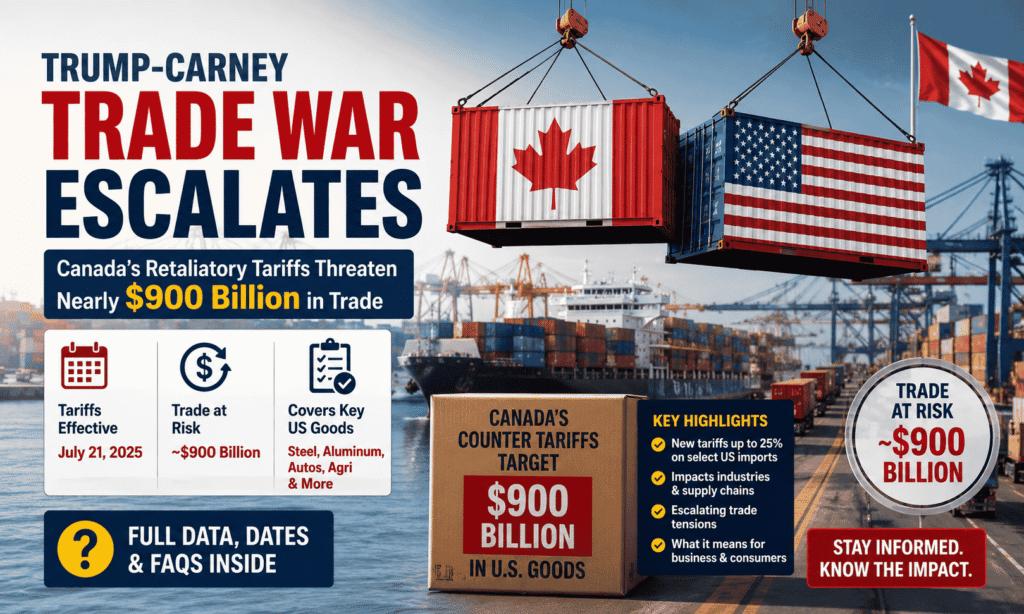
The Trump-Carney trade war has entered its most dangerous phase yet, with Canada confirming that its retaliatory tariffs on US goods will take effect on September 8, 2026, dollar for dollar against the 50 percent duties Washington imposed on roughly 20 billion dollars of Canadian products. Canadian Prime Minister Mark Carney walked away from trade talks with the Trump administration late on August 21, 2026, calling the terms being demanded “uneconomic” and “unfair,” a breakdown that pushed one of the world’s largest and most integrated trading relationships to the brink of open economic conflict. With annual two-way trade in goods and services between the two countries running close to 900 billion dollars, the scale of what is now at stake has jumped from a regional dispute into a continental economic story.
The collapse did not happen overnight. It followed months of tit-for-tat tariff actions stretching back to early 2025, when President Donald Trump first imposed sweeping duties on Canadian imports, and it comes just weeks after Trump signed new proclamations raising tariffs on a broad range of Canadian products, effective August 19, 2026. Carney, a former central banker who took office in 2025, has repeatedly said Canada would not accept a deal that “undermined the net benefits for Canadians,” and has now committed his government to a direct, matching retaliation strategy. We’ll be updating this article monthly as new tariff data, trade figures and negotiation updates emerge from Ottawa and Washington.
Latest Update: Where the Trump-Carney Trade War Stands Today
As of August 25, 2026, the United States has imposed 50 percent tariffs on approximately 20 billion dollars worth of Canadian goods, a category that includes wine, hockey sticks, cement, building materials, liquor and select clothing items. These duties took effect at midnight on August 22, 2026, immediately after negotiations between Ottawa and Washington broke down. In direct response, Carney announced that Canada will impose matching, dollar-for-dollar retaliatory tariffs on US imports beginning September 8, 2026, targeting an estimated 27.6 billion Canadian dollars, or roughly 20 billion US dollars, worth of American products.
Carney has said the retaliatory measures will be concentrated in sectors including steel, dairy, appliances, agricultural equipment, pulp and paper, and electronics, all industries with heavy cross-border supply chains and significant employment on both sides of the border. Trump, in turn, threatened on August 24, 2026, to raise tariffs on Canadian automobiles, auto parts and steel to 50 percent starting January 1, 2027, a move that would strike directly at one of the most tightly integrated manufacturing sectors in North America. The Canadian dollar has already slid on currency markets as investors price in the risk of a prolonged standoff between the two economies.
Key Highlights: Trump-Carney Trade War Timeline and Tariff Data
| Event or Data Point | Detail | Date |
|---|---|---|
| US tariffs on Canadian goods take effect | 50 percent duties on approximately 20 billion dollars of goods | August 22, 2026 |
| Canada-US trade talks collapse | Carney calls US terms uneconomic and unfair | August 21, 2026 |
| Canada announces retaliatory tariffs | Dollar-for-dollar matching tariffs on roughly C$27.6 billion of US goods | Effective September 8, 2026 |
| Trump threatens auto and steel tariff hike | Proposed 50 percent tariff on Canadian cars, auto parts and steel | Effective January 1, 2027 |
| Total US goods imported from Canada, 2024 | Approximately 382 billion dollars | Full year 2024 |
| Total US goods exported to Canada, 2024 | Over 333 to 349 billion dollars | Full year 2024 |
| US goods and services trade deficit with Canada | Approximately 35.7 billion dollars | 2024 full year |
| US services trade surplus with Canada | Approximately 33 billion dollars | 2024 full year |
| Share of Canadian goods exports hit by new tariffs | Around 5 percent of total | As of August 2026 |
| Softwood lumber imported by US from Canada | More than 80 percent of all US softwood lumber imports | 2026 estimate |
| Canadian auto sector jobs at risk | Estimated 500,000 jobs tied to the auto industry | 2026 estimate |
| Estimated cost of tariffs to General Motors | Between 4 billion and 5 billion dollars this year | 2026 company estimate |
These figures reflect the most recent government and industry data available as of August 2026 and will be revised as new numbers are released.
Why Did the Trump-Carney Trade Talks Collapse?
The breakdown between Washington and Ottawa did not stem from a single disagreement but from a buildup of tension that has been simmering since Trump’s second term began. According to Carney, the United States proposed new terms in the final days of negotiation that he described as offering too little while demanding too much, effectively asking Canada to accept concessions that would not deliver a fair economic outcome for Canadian workers and industries. Trump, for his part, has repeatedly and inaccurately claimed the US subsidizes Canada by as much as 200 billion dollars a year, a figure that official US trade data does not support. The real 2024 goods and services trade deficit with Canada stood at roughly 35.7 billion dollars, a fraction of what Trump has publicly claimed, and that deficit is largely offset by a US services trade surplus with Canada of about 33 billion dollars.
Trump has also used the trade dispute to revive earlier rhetoric about Canadian sovereignty, including social media posts suggesting the US could rename Lake Ontario or reduce business ties with the province of Ontario altogether. Carney has responded firmly, declaring in past remarks that “Canada doesn’t live because of the United States. Canada thrives because we are Canadian,” a message he has repeated as tensions escalated through 2026.
2027 VA Disability COLA Increase: How Much Could Benefits Rise Under the Latest Projection
How Canada’s Retaliatory Tariffs Will Hit the US Economy
Canada’s decision to match US tariffs dollar for dollar starting September 8, 2026 is designed to inflict maximum pressure on American exporters while limiting collateral damage to Canadian consumers, though Carney himself has acknowledged the retaliation “will raise costs and reduce choice for Canadians.” The targeted sectors, steel, dairy, appliances, agricultural equipment, pulp and paper, and electronics, were chosen specifically because they represent politically and economically significant US export categories, several of which are concentrated in states along the northern US border.
Economists tracking the standoff say the impact will be uneven. ING’s chief international economist has noted that while the new tariffs apply to only about 5 percent of Canada’s total goods exports to the US, meaning the overall macroeconomic hit will not be a “hammer blow,” the effect on individual companies, particularly small and medium-sized businesses in border states, could be severe. Capital Economics has gone further, warning that the most exposed Canadian industries “could be crippled” by tariffs at this scale, particularly manufacturers with thin margins and limited ability to shift supply chains quickly.
Impact on the US-Canada Auto and Manufacturing Sector
The automotive sector remains the single biggest flashpoint in the Trump-Carney trade war. Trump’s threat to raise tariffs on Canadian vehicles, auto parts and steel to 50 percent starting January 1, 2027 would strike at an industry that accounts for more than 10 percent of intraregional North American trade, representing hundreds of billions of dollars in cross-border flows and millions of jobs across the US, Canada and Mexico. General Motors CEO Mary Barra has already stated publicly that existing tariffs will cost her company between 4 billion and 5 billion dollars this year alone, and further escalation would likely push those costs even higher, with much of that expense eventually passed on to consumers through higher vehicle prices.
Roughly 500,000 Canadian jobs are tied directly to the auto manufacturing sector, and Carney has previously warned that unchecked US auto tariffs could “devastate” that workforce. Canada launched a two billion Canadian dollar strategic response fund earlier in the trade dispute specifically to help cushion the auto industry against tariff shocks, a signal of how central this sector is to Ottawa’s overall economic strategy.
Impact on Everyday Businesses and Consumers
Beyond heavy industry, small and mid-sized businesses on both sides of the border are already absorbing real costs. One US baby products company owner told reporters that a single shipping container of goods that previously cost far less now costs nearly 230,000 dollars to bring into the country because of existing tariffs, a scale of increase that threatens to put smaller import-dependent businesses out of operation entirely. The Federal Reserve’s Beige Book survey has also flagged a noticeable drop in Canadian tourism to the US, with businesses in border regions reporting fewer Canadian visitors and a direct hit to local revenue as a result of the deteriorating relationship.
For Canadian consumers, retaliatory tariffs on US goods are expected to raise prices on a range of everyday products, from appliances to processed food items, since many of these goods have no easy domestic substitute in the short term. Carney’s government has said it will continue evaluating support measures for affected industries as the September 8 tariff implementation date approaches.
Why Almost $900 Billion in Trade Is Now At Risk
Canada and the United States operate one of the largest bilateral trading relationships in the world. In 2024 alone, the US imported approximately 382 billion dollars worth of goods from Canada while exporting more than 333 billion dollars worth of goods back, a combined goods trade flow of roughly 715 billion dollars. When services trade, which includes tourism, financial services, technology and other cross-border commerce, is added on top of goods trade, the total two-way economic relationship approaches the 900 billion dollar mark that has become central to how economists and policymakers are now framing the risk of this dispute. Canada remains the top single destination for US exports and is the United States’ second-biggest trading partner after Mexico, while the US absorbs more than three-fourths of all Canadian exports, including softwood lumber, steel, aluminum and energy products.
This deep interdependence is exactly why economists warn that an extended trade war carries risk for both economies simultaneously, rather than functioning as a one-sided punishment. About 30 percent of the softwood lumber consumed in the United States is imported, and Canada supplies more than 80 percent of that total, meaning sustained tariff escalation could push up US construction and housing costs at a time when affordability is already a major economic concern. Canada, meanwhile, sends the overwhelming majority of its total exports to the US, leaving Ottawa with limited room to fully replace that market even as it pursues diversification toward Europe and Asia.
$994 SNAP Benefit: New Work Rules Hit Millions as SNAP E&T Program Explained
CRS Score Distribution 2026: 5 Trends Shaping the Next Express Entry Draw
New Canada LMIA Rules August 2026: What Employers and Foreign Workers Need to Know
Canada’s Push to Diversify Away From the US
Carney has been explicit that this trade war has accelerated Canada’s long-term strategy to reduce economic dependence on the United States. His government has pursued closer trade ties with China, including a deal to lower tariffs on Chinese electric vehicles in exchange for reduced Chinese import taxes on Canadian farm products, a move that briefly drew criticism from Trump before he threatened a 100 percent tariff on all Canadian goods if Ottawa proceeded further down that path. Analysts at Eurasia Group have warned that no country will be as “profoundly affected” by ongoing US political and trade turbulence in 2026 as Canada, and that Canada’s diversification efforts will face “powerful headwinds” even as they continue.
Whether Canada can meaningfully reduce its reliance on the US market in the near term remains uncertain, given how deeply integrated supply chains, energy infrastructure and manufacturing networks are between the two countries after decades under the North American Free Trade Agreement and its successor, the United States-Mexico-Canada Agreement.
What Happens Next in the Trump-Carney Trade War
The most immediate deadline to watch is September 8, 2026, when Canada’s retaliatory tariffs on US goods officially take effect. After that, attention shifts to January 1, 2027, when Trump’s threatened 50 percent tariffs on Canadian autos, auto parts and steel are scheduled to begin unless a new agreement is reached before then. Both sides have signaled they remain open to renewed talks, but Carney has made clear that Canada will not accept terms it views as one-sided, while Trump has continued to publicly insist that current tariff levels are simply “the way it is.”
How to Track Official Updates and Verify Tariff Details
Businesses, importers and exporters on both sides of the border are strongly advised to monitor official government channels directly rather than relying solely on news coverage, since tariff rates, effective dates and product exclusion lists have changed multiple times over the course of this dispute and are likely to change again before the September and January deadlines.
Official Trade and Tariff Resources
| Resource | Purpose | Official Link |
|---|---|---|
| Office of the US Trade Representative | Official US tariff actions, proclamations and trade policy updates | https://ustr.gov |
| US Customs and Border Protection | Tariff classification, duty rates and import compliance | https://www.cbp.gov |
| Global Affairs Canada | Canada’s official trade policy and retaliation measure announcements | https://www.international.gc.ca |
| Canada Border Services Agency | Canadian tariff schedules and counter-tariff implementation details | https://www.cbsa-asfc.gc.ca |
| Prime Minister of Canada, Official Newsroom | Official statements from Mark Carney’s government on trade actions | https://www.pm.gc.ca |
| The White House | Official US presidential proclamations on tariffs | https://www.whitehouse.gov |
| US Census Bureau, Foreign Trade Division | Official bilateral trade data between the US and Canada | https://www.census.gov/foreign-trade |
Always verify current tariff rates and effective dates on these official portals, since the situation is evolving rapidly and figures reported in the media can shift within days.
FAQs
What is the Trump-Carney trade war about?
The Trump-Carney trade war is a tariff dispute between the United States and Canada that escalated in August 2026 after trade talks collapsed, leading the US to impose 50 percent tariffs on Canadian goods and Canada to announce matching retaliatory tariffs on US products.
How much is at risk in the US-Canada trade war?
Nearly 900 billion dollars in combined annual goods and services trade between the US and Canada is considered at risk if the tariff dispute continues to escalate, based on 2024 bilateral trade data from official US and Canadian trade agencies.
When do Canada’s retaliatory tariffs on US goods start?
Canada’s dollar-for-dollar retaliatory tariffs on roughly 20 billion dollars worth of US goods are scheduled to take effect on September 8, 2026, according to Prime Minister Mark Carney’s official announcement.
Will Trump raise tariffs on Canadian cars and steel?
Trump has threatened to raise tariffs on Canadian automobiles, auto parts and steel to 50 percent starting January 1, 2027, though this remains subject to change depending on the outcome of future negotiations.
Why did trade talks between Trump and Carney break down?
Talks broke down on August 21, 2026 after Carney said the United States proposed new terms he considered uneconomic and unfair, prompting Canada to walk away from negotiations just before new US tariffs took effect.
How will the trade war affect prices in Canada and the US?
Consumers on both sides are likely to see higher prices on tariffed goods, including steel, dairy, appliances, electronics, wine and building materials, as businesses pass on increased import costs from the ongoing tariff dispute.
Is Canada trying to reduce its dependence on the United States?
Yes, Prime Minister Mark Carney has pursued trade diversification, including new economic ties with China and Europe, as part of a broader strategy to reduce Canada’s reliance on the US market amid ongoing trade tensions.
Conclusion
The Trump-Carney trade war has moved past rhetoric into a full-blown tariff confrontation, with real deadlines, real dollar figures and real consequences for businesses and workers on both sides of the border. With Canada’s retaliatory tariffs set to take effect September 8, 2026 and a further escalation threatened for January 1, 2027 on autos and steel, nearly 900 billion dollars in annual bilateral trade now sits under a cloud of uncertainty. For importers, exporters, auto manufacturers and everyday consumers, the coming months will determine whether this dispute settles into a new, more expensive normal or whether renewed negotiations can pull both economies back from deeper economic damage. This article will be reviewed and updated monthly as new tariff data, negotiation outcomes and economic impact figures become available.
Indian Student Applications to US Colleges Fall 15% Amid Visa Uncertainty: What the New Data Shows