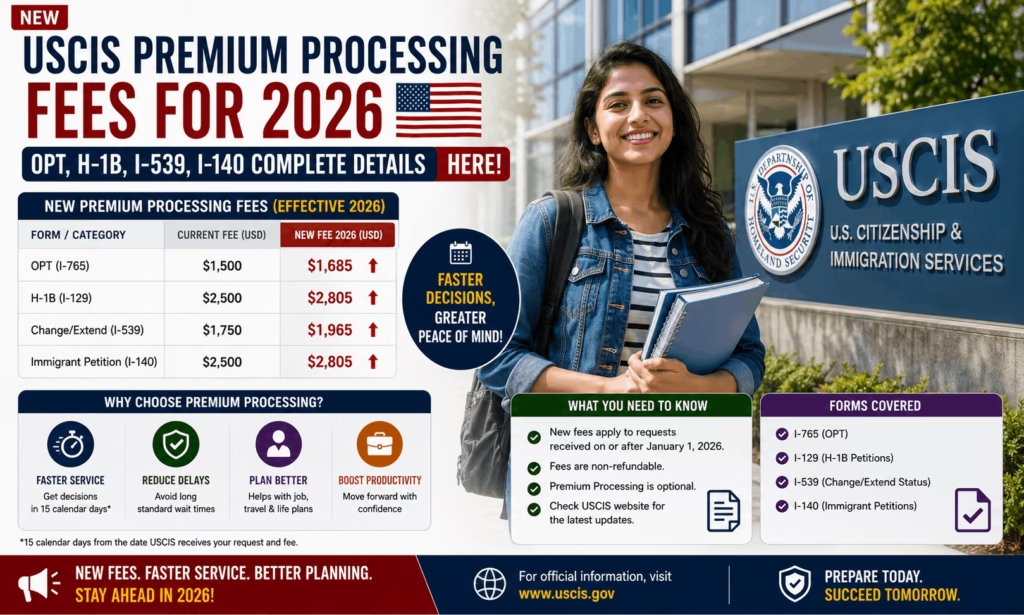
US H-1B L-1 Visa Extension Fee Hike: The Department of Homeland Security has finalized a rule that will make it significantly more expensive for certain US employers to keep their H-1B and L-1 employees on staff. Published in the Federal Register on August 10, the new regulation expands an existing $4,000 fee on H-1B petitions and a $4,500 fee on L-1 petitions to cover extension filings for the first time, not just new hires and employer transfers as before. The rule takes effect roughly 30 days after publication, meaning it will apply to extension petitions filed from around September 9 onward, and it lands squarely on the group of employers that rely most heavily on Indian talent.
This matters immediately because Indian nationals accounted for more than 226,000 H-1B extension approvals in fiscal year 2025 alone, close to 78 percent of all H-1B renewals granted that year. For years, the extra $4,000 or $4,500 charge only applied when a company filed a brand new H-1B or L-1 petition, or when a worker switched employers. Extensions with the same employer, the most common filing for someone already working in the US, were exempt. That exemption is now gone for a specific category of employer, and the change comes at a time when Indian professionals are still adjusting to an earlier, much larger fee hike affecting new H-1B applicants. We’ll be updating this article monthly as new guidance and enforcement details come out.
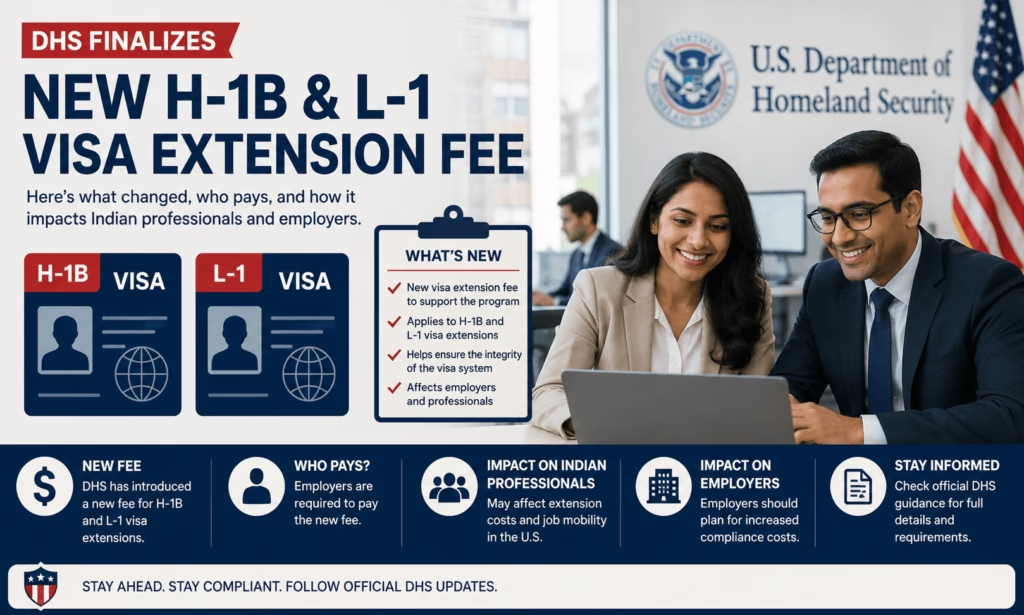
What Exactly Changed With the H-1B and L-1 Extension Fee
The fee at the center of this change is officially called the 9-11 Response and Biometric Entry-Exit Fee, created under a 2015 law to help fund biometric entry and exit systems at US borders. Since it was introduced, the fee applied to initial H-1B and L-1 petitions and to petitions where a worker changed employers, but Homeland Security had, until now, interpreted the law as excluding same-employer extension petitions.
DHS says that interpretation was incorrect. In its final rule, the department stated that the biometric fee was always meant to apply to all extension of status petitions, even in situations where a related fraud-prevention fee does not apply. As a result, the fee now reaches the largest and most routine category of filing for foreign workers already living and working in the United States, the straightforward renewal.
The dollar amounts themselves have not changed. Employers that meet the criteria still pay $4,000 per H-1B petition and $4,500 per L-1 petition. What has changed is the scope of filings the fee applies to. According to DHS estimates, only about 27 percent of H-1B petitions filed by covered employers were subject to this fee between fiscal years 2018 and 2025. Under the new interpretation, roughly 75 percent of those employers’ H-1B petitions will now be subject to it, since most filings by these companies are extensions.
Service Canada Benefit Payments August 2026 Dates, Amounts and Who Qualifies
Government Shutdown Stopgap Spending Bill: Senate Passes Funding Patch Through December 11
USPS Operational Restructuring: Latest Updates on Cash Crisis and Network Overhaul
Free Money From the USA Government: Real Programs You Can Actually Get
Who Actually Has to Pay This Fee
This is the detail causing the most confusion, and it is worth stating clearly. The fee does not apply to every company that sponsors H-1B or L-1 workers. It applies only to employers that meet two specific conditions at the same time, commonly referred to as the 50-50 rule.
An employer must have at least 50 employees in the United States, and more than 50 percent of that US workforce must be on H-1B, L-1A, or L-1B status. Companies that meet both thresholds are the ones required to pay the additional fee on every covered petition, including extensions going forward. Smaller employers, and companies where H-1B and L-1 workers make up a minority of the US workforce, are not affected by this particular fee.
In practice, this rule is aimed squarely at large IT services, staffing, and outsourcing firms, many of which are Indian-headquartered or have a heavy concentration of Indian employees on their US payroll. It is also worth noting that the fee is charged to the employer, not the worker. Legally, the individual visa holder is never billed directly for this charge, though the cost pressure on the sponsoring company can still shape decisions that affect the employee.
US H-1B L-1 Visa Extension Fee Hike Key Facts and Dates
| Detail | Information |
|---|---|
| Fee amount for H-1B | $4,000 per covered petition |
| Fee amount for L-1 | $4,500 per covered petition |
| Final rule published | August 10, 2026, in the Federal Register |
| Effective date | Approximately September 9, 2026, 30 days after publication |
| Who pays | Employers meeting the 50-50 rule, not individual workers |
| Employer threshold | 50 or more US employees, with over 50% on H-1B or L-1 status |
| Newly covered filings | Same-employer extension of stay petitions |
| Previously covered filings | Initial petitions and change-of-employer petitions |
| Estimated additional federal revenue | Approximately $37.9 million in fiscal 2026 and $40 million in fiscal 2027 |
| Scheduled end of fee collection under current law | September 30, 2027 |
How This Differs From the Earlier $100,000 H-1B Fee
Indian professionals may recall a separate, much larger fee announcement from 2025, when the Trump administration proposed a $100,000 charge tied to new H-1B petitions filed for workers outside the United States. That fee generated significant alarm at the time, though USCIS later clarified it applies only to new petitions filed for beneficiaries outside the US who do not already hold a valid H-1B visa, and does not apply to individuals already in the country seeking an extension of stay or change of status.
The new extension fee announced this week is a separate and distinct charge. It does not replace or reduce the $100,000 fee framework, and it is not connected to the litigation currently surrounding that larger fee, which a federal court had blocked before an appeals court declined to pause that ruling. Instead, this new rule expands the smaller, older 9-11 Response Fee into a category of filing, same-employer extensions, that previously escaped it entirely. For most working professionals already in the US on H-1B or L-1 status with a qualifying employer, this extension fee is the one that will actually show up on their next renewal cycle.
Why Indian Professionals Are Most Exposed
The scale of the impact on Indian nationals comes down to simple filing volume. USCIS data shows that of the roughly 406,685 H-1B petitions approved in fiscal year 2025, about 291,000 were extension of employment petitions rather than new hires. Indian nationals made up more than 226,000 of those extension approvals, close to 78 percent of the total. Since H-1B status is typically granted in three-year increments and most professionals need at least one extension to reach the six-year cap, or additional extensions while a green card application is pending, a large share of Indian H-1B holders will eventually be affected by this rule if their employer meets the 50-50 threshold.
The employers most likely to meet that threshold are large IT services and consulting companies, several of which are Indian-headquartered multinationals with a workforce composition heavily weighted toward H-1B and L-1 employees. For these companies, the extension fee adds a recurring, predictable cost every time a visa comes up for renewal, on top of existing legal, filing, and premium processing fees.
Weekly Jobless Claims Report: 199,000 Filings Signal Labor Market Cooling
Federal Employee RIF Rules 2026: What the New OPM Regulations Actually Change
IRS Releases New Details on the Saver’s Match Program: Up to $1,000 for Your Retirement Account
IRS SSA Advanced Leave Suspension: What Federal Employees Need to Know
Small Personal Loans for Bad Credit USA: Direct Lenders With Same-Day Approval and Funding
What This Could Mean in Practice for Workers and Employers
For an individual Indian professional, the immediate financial exposure is limited, since the fee is billed to the employer, not the employee. The more realistic impact is indirect. Employers facing higher renewal costs may become more selective about who they continue to sponsor, may push back extension filings closer to expiration dates to manage cash flow, or may pass on some of the added cost through slower salary growth or reduced non-immigrant hiring in the coming cycles.
Workers whose current employer does not meet the 50-50 threshold will likely see no direct impact from this specific rule. Workers at large, visa-heavy employers may want to confirm with their employer’s immigration counsel or HR team whether the company falls under the new requirement, and build in extra lead time before their current status expires, since employers may adjust internal filing timelines in response to the added cost.
It is also worth noting what this rule does not do. DHS stated it does not expect the expanded fee to reduce the overall number of H-1B workers hired each year, since annual demand for H-1B visas has exceeded the statutory cap for more than a decade regardless of fee levels. The rule changes the cost of maintaining status for existing visa holders, not the number of visas available.
Official Resources for H-1B and L-1 Visa Holders
| Resource | Link |
|---|---|
| USCIS H-1B specialty occupations overview | https://www.uscis.gov/working-in-the-united-states/h-1b-specialty-occupations |
| USCIS L-1 intracompany transferee overview | https://www.uscis.gov/working-in-the-united-states/l-1a-intracompany-transferee-executive-or-manager |
| Check the status of a filed petition | https://egov.uscis.gov/casestatus/landing.do |
| USCIS online account login | https://myaccount.uscis.gov/ |
| USCIS fee schedule and filing information | https://www.uscis.gov/g-1055 |
| Federal Register, official rule text | https://www.federalregister.gov/ |
US H-1B L-1 Visa Extension Fee Hike FAQs
Do individual H-1B or L-1 workers have to pay the new extension fee themselves?
No. The fee is legally required to be paid by the sponsoring employer, not the individual visa holder, though the cost may influence how employers plan future filings.
Does this new fee apply to every company that sponsors H-1B or L-1 workers?
No. It only applies to employers with at least 50 US employees where more than half of that workforce holds H-1B, L-1A, or L-1B status, often called the 50-50 rule.
Is this the same as the $100,000 H-1B fee announced in 2025?
No. The $100,000 fee applies only to certain new H-1B petitions filed for workers outside the United States, and does not apply to extensions or change of status filings for people already in the US. This new fee is a separate, smaller charge that now covers same-employer extension petitions.
When does the new extension fee take effect?
The final rule was published in the Federal Register on August 10, 2026, and takes effect approximately 30 days later, around September 9, 2026.
Will this rule reduce the number of H-1B visas issued each year?
DHS has stated it does not expect the fee expansion to reduce overall H-1B hiring, since demand for H-1B visas has consistently exceeded the annual cap regardless of fee changes.
How can I find out if my employer is affected by the 50-50 rule?
This depends on your employer’s total US headcount and the proportion of that workforce on H-1B or L-1 status. Employees can ask their HR or immigration counsel directly, since this information is not typically published by individual companies.
Why are Indian professionals specifically highlighted in coverage of this rule?
Indian nationals represented close to 78 percent of all H-1B extension approvals in fiscal year 2025, and many work for large IT services and consulting firms that are more likely to meet the 50-50 employer threshold, making this group more exposed to the fee than other nationalities on average.
Conclusion
The expanded H-1B and L-1 extension fee marks a real shift in how routine visa renewals are priced for a specific category of large, visa-heavy employers, even though the charge itself is not new. For Indian professionals, who make up the overwhelming majority of H-1B extension filings each year, the practical effect will depend heavily on whether their employer meets the 50-50 threshold that triggers the fee. Workers at major IT services and consulting firms should expect their employers to factor this cost into future renewal planning, while those at smaller or less visa-concentrated companies are unlikely to see any direct change. As the rule takes effect in September, expect further guidance from USCIS and immigration counsel on how filings will be processed under the new requirement.
Social Security $200 Monthly Increase 2027: Which Seniors Qualify for the Biggest Raise?
H-1B 60-Day Grace Period Elimination: What US Visa Workers Should Know
450,000 Borrowers Student Debt Erased: How to Check If You Qualify?
Can You Change Your Social Security Payment Date? Here’s the SSA Answer
VA Hospice Benefits: What Can They Cover and How Do You Know If You’re Eligible