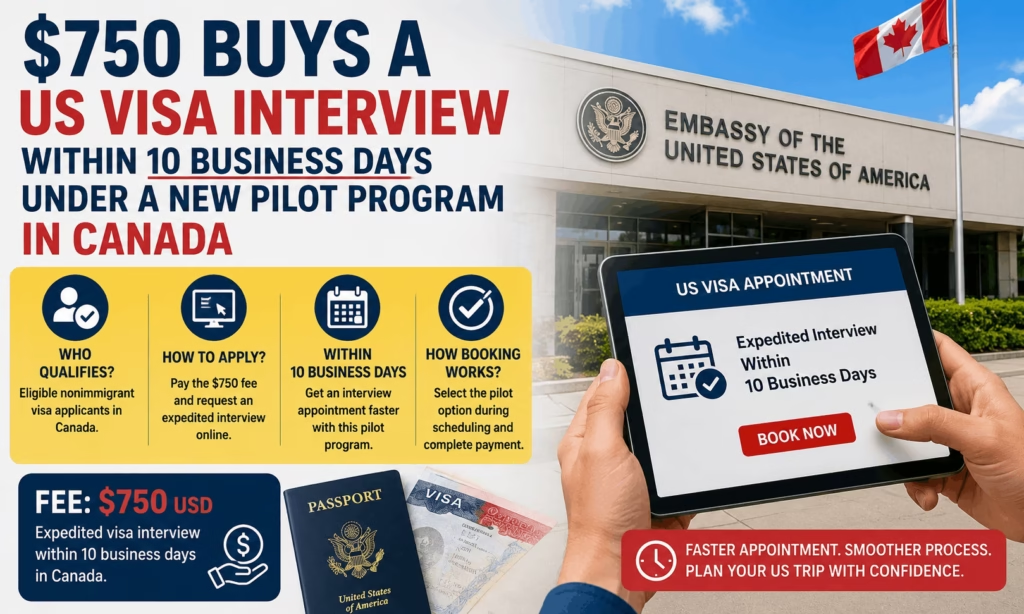
$750 US Visa Early Appointments: Applicants facing wait times stretching well past a year for a US visitor visa interview in Canada now have a new, faster option, but it comes with a price tag. Starting August 18, 2026, the U.S. Department of State began allowing eligible B-category visitor and business visa applicants at consular posts across Canada to pay US$750 to secure an interview appointment within 10 business days, subject to slot availability, under a new Paid Expedite pilot program. We’ll be updating this article monthly, so check back here for the latest wait time data, pilot program updates, and any changes to eligibility or pricing as the State Department refines the program through its scheduled end date.
For anyone who has tried to book a US visa interview in Canada over the past year, the scale of the problem this new option is trying to solve will not come as a surprise. Standard B1/B2 visitor visa appointments at major Canadian posts have been running so far behind that some locations have shown wait times stretching past a year, with certain consulates displaying dates pushing into 2027 and even early 2028 for applicants without qualifying emergency circumstances. Against that backdrop, a $750 US visa early appointment option that promises an interview slot within 10 business days represents a meaningful, if costly, alternative for travelers whose plans simply cannot wait that long, and understanding exactly how this new pilot works, who actually qualifies, and how it fits alongside the existing emergency appointment system has become essential reading for anyone applying from Canada.
What the Paid Expedite Pilot Program Actually Offers
The Paid Expedite option allows eligible applicants to pay an additional fee, on top of the standard visa application fee, in exchange for the ability to schedule a consular interview appointment within 10 business days, whenever expedited slots are actually available at that specific post. This is explicitly framed by the State Department as a voluntary, optional pathway that exists entirely separate from the standard visa application process every applicant must still complete in full, meaning paying the fee does not change any of the underlying requirements for the visa itself, including the DS-160 application, standard documentation, and the interview process.
Canada is one of six participating locations currently included in this pilot program, which the State Department has structured to run through December 31, 2026, giving both the department and applicants a defined window to evaluate how the option performs before any decision is made about extending, modifying, or ending it.
Key Facts and Latest Pilot Program Highlights
| Detail | Information |
|---|---|
| Program name | Paid Expedite appointment pilot |
| Administered by | U.S. Department of State, Bureau of Consular Affairs |
| Launch date | August 18, 2026 |
| Pilot program end date | December 31, 2026 |
| Expedite fee | US$750, in addition to standard visa fees |
| Guaranteed appointment window | Within 10 business days of payment, subject to slot availability |
| Eligible visa categories | B-category visitor and business visas (B1/B2) |
| Number of participating locations globally | Six missions, including Canada |
| Standard B1/B2 MRV visa fee | US$185 |
| Refund and reschedule policy | Strict no-refund, no-reschedule once paid |
| Recent standard wait times, Calgary | Approximately 22 months to next available B1/B2 slot |
| Recent standard wait times, Toronto | Approximately 17 months to next available B1/B2 slot |
| Recent standard wait times, Vancouver | Approximately 13 months to next available B1/B2 slot |
| Regular emergency appointment criteria | Still available, based on documented urgent need |
Why the State Department Launched This Option Now?
The timing of this pilot is directly tied to an extraordinary backlog that has built up at US consular posts across Canada throughout 2026. Multiple overlapping factors have driven demand to unusually high levels, including a wave of renewal applicants returning to the system, evolving cross-border travel and documentation requirements, and guidance issued in December 2025 instructing applicants to schedule their interview in their country of nationality or residence rather than at a foreign post, a policy shift that effectively pushed many Canada-resident applicants, including numerous third-country nationals who previously applied elsewhere, into the Canadian queue specifically.
The scale of the resulting backlog has been striking. Snapshot data from the State Department’s own Global Visa Wait Times tracker showed some Canadian posts displaying wait times for standard, interview-required B1/B2 appointments stretching close to two years in the most extreme cases, effectively pushing realistic appointment dates for some applicants into 2027 or even early 2028. Against that backdrop, the Paid Expedite pilot gives the department a mechanism to offer meaningful relief to a subset of travelers with genuinely time-sensitive needs, without attempting to solve the underlying capacity and staffing constraints driving the broader backlog itself.
Who Actually Qualifies for the $750 Expedite Option?
The Paid Expedite program is specifically targeted at applicants applying for B-category visitor and business visas, meaning the standard B1/B2 classification covering tourism, family visits, and short-term business travel. It is not, based on current program details, structured as a universal option available to every visa category or every applicant regardless of circumstance.
The option has been described as particularly useful for two overlapping groups of travelers. The first group includes applicants with genuinely time-sensitive travel needs that do not meet the specific documented urgency criteria required for the existing, no-cost emergency appointment system, such as medical emergencies, imminent school start dates, or family emergencies like a funeral. The second group includes applicants who did attempt to request a standard emergency appointment through the existing process but had that request denied, giving them a paid fallback option rather than being left entirely dependent on the standard multi-month or multi-year queue.
Because the Paid Expedite option operates independently of, rather than as a replacement for, the existing emergency appointment system, applicants who do meet standard emergency criteria may still find it worthwhile to pursue that no-cost pathway first before considering whether the $750 paid option makes sense for their specific situation.
How to Apply for a Paid Expedite Appointment in Canada?
Applying for the Paid Expedite option does not replace any part of the standard visa application process; it functions as an add-on step layered on top of the normal application. Every applicant, regardless of whether they intend to use the expedite option, first needs to complete the standard DS-160 online nonimmigrant visa application form, providing personal, travel, and background details accurately, since inconsistencies at this stage can create complications later in the process regardless of appointment speed.
After completing the DS-160 and paying the standard MRV visa application fee, which sits at US$185 for B1/B2 visitor and business visa categories, applicants proceed to the official appointment scheduling system, commonly known as the AIS portal, to check whether their intended consular post is showing standard appointment availability or whether they wish to pursue the Paid Expedite option instead. Applicants interested in the expedite pathway pay the additional US$750 fee through the designated payment mechanism tied to this specific pilot program, which then makes them eligible to be scheduled into an appointment slot within 10 business days, contingent on expedited slots actually being available at that time for their specific post.
Given the strict no-refund and no-reschedule policy attached to the paid option, applicants are strongly encouraged to confirm their travel timeline and eligibility circumstances carefully before paying the fee, since once payment is made, there is no described mechanism to recover the cost or shift the appointment if plans subsequently change or if the applicant later decides the standard queue would have worked after all.
Paid Expedite Processing Time: What to Expect After You Pay?
The central value proposition of this pilot program is speed, and the State Department has structured the option around a specific, defined processing window rather than the open-ended uncertainty applicants currently face under the standard system. Once an eligible applicant pays the $750 fee and a Paid Expedite slot is confirmed as available at their chosen post, the appointment itself is scheduled to occur within 10 business days of that payment, a dramatically compressed timeline compared to the many months, and in some Canadian cases, multiple years, applicants are otherwise experiencing under standard scheduling.
It is important to understand that this 10-business-day window applies specifically to securing the actual interview appointment slot, not to the full visa issuance timeline. Standard post-interview processing, including any additional administrative processing sometimes referred to informally by its associated visa refusal code, 221(g), when a case requires further review, still applies after the expedited interview takes place, meaning the Paid Expedite option accelerates access to the interview itself but does not necessarily guarantee an equally accelerated final visa decision if a particular case requires additional review following that interview.
Because the option is explicitly described as subject to availability, there is also no absolute guarantee that a Paid Expedite slot will be available at the exact moment an applicant wishes to pay the fee, meaning some applicants may find themselves needing to check back or wait briefly for a qualifying slot to open even within this expedited system, though the overall design intent is clearly to deliver a meaningfully faster outcome than the standard queue currently offers.
Hawaii TDI 2026: New Weekly Benefit Rate, Eligibility & Payment Rules
$1,636 ODSP and Canada Disability Benefit Now Stack Fully in Ontario, No Clawback on Either Payment
$4427 EITC Payment: How to Know If You Qualify and When Will You Get It?
Paid Expedite Fee and Payment Schedule: What Applicants Need to Know?
Because this program centers on a one-time service fee rather than a recurring benefit payment, the “payment schedule” for Paid Expedite functions differently than it would for an ongoing government benefit program. The $750 fee is paid as a single, upfront charge at the point an applicant chooses to pursue the expedited scheduling option, layered on top of the standard, separately paid MRV visa application fee of US$185 for B1/B2 categories, meaning the true out-of-pocket cost for an applicant using this pathway totals both fees combined rather than the $750 figure alone.
Unlike the standard MRV visa fee, which remains valid for one year from the date of payment and can technically support a scheduling attempt at any point within that window, the Paid Expedite fee is tied specifically to securing an appointment within the near-term 10-business-day window at the time of payment, and it carries a strict no-refund and no-reschedule policy once paid. This means applicants should treat the $750 payment as a final, committed decision rather than a flexible option that can be adjusted or reversed if circumstances change after payment is submitted, a meaningfully different structure from many other government fee schedules that allow for at least partial refunds or rescheduling under certain conditions.
Weighing Whether the $750 Fee Is Worth It
Given the substantial cost involved, the decision to use the Paid Expedite option realistically comes down to weighing the value of that 10-business-day timeline against both the applicant’s actual travel urgency and their realistic odds of otherwise securing a standard appointment sooner than expected. Standard appointment wait times at Canadian posts have shown some variability, and posts do periodically release additional standard appointment slots, meaning some applicants who book the earliest available standard date and then continue monitoring for earlier openings occasionally succeed in securing a meaningfully earlier appointment without paying any additional expedite fee at all.
For applicants without a genuinely urgent, time-sensitive reason for travel, waiting for standard appointment availability, while continuing to check periodically for earlier openings that consulates add to the system over time, may remain the more financially sensible choice, particularly given the Paid Expedite option’s firm no-refund and no-reschedule terms. For applicants with real, near-term travel deadlines who do not meet the documented criteria for a no-cost emergency appointment, however, the $750 fee may represent a genuinely worthwhile trade-off against the alternative of missing time-sensitive travel altogether while waiting out a queue that, at several Canadian posts, has recently stretched well over a year.
How This Fits Alongside Existing Emergency Appointment Options?
It is worth being clear that the Paid Expedite pilot does not replace the State Department’s existing, no-cost emergency appointment request system, which remains available to applicants who can demonstrate a qualifying urgent need, such as a medical emergency, an imminent school start date, or a family emergency like a funeral. That existing system continues to operate exactly as it did before this pilot launched, and applicants who believe they may qualify under those established emergency criteria are generally encouraged to pursue that no-cost pathway first, since it carries no financial cost beyond the standard visa application fee itself.
The Paid Expedite option is better understood as filling a specific gap for applicants who fall outside those narrower emergency criteria but still face genuinely pressing travel timelines, as well as for the subset of applicants whose emergency appointment request was reviewed and specifically denied, giving that group an alternative path forward rather than defaulting entirely back into the standard, multi-month or multi-year queue.
Trump Halts 50 Percent Tariffs Canada: What the Last Minute Deal With Ottawa Means
Green Card Rule Changes: New Public Charge Test to Assess Age, Health, Family Status and Finances
Official Resources and Links
| Resource | Purpose | Link |
|---|---|---|
| U.S. Department of State visa appointment information | Official guidance on scheduling and expedited options | https://travel.state.gov |
| CGI Federal AIS portal | Book, check, or manage a US visa appointment in Canada | https://ais.usvisa-info.com |
| US Embassy and Consulates in Canada | Post-specific contact information and updates | https://ca.usembassy.gov |
| Global Visa Wait Times tracker | Check current standard appointment wait times by post | https://travel.state.gov/content/travel/en/us-visas/visa-information-resources/wait-times.html |
| DS-160 online nonimmigrant visa application | Required application form for all applicants | https://ceac.state.gov/genniv |
| MRV visa fee payment information | Pay the standard visa application fee | https://ais.usvisa-info.com |
FAQs
What is the new $750 US visa appointment option in Canada?
It is a Paid Expedite pilot program launched August 18, 2026, allowing eligible B-category visitor and business visa applicants at Canadian consular posts to pay US$750 for an interview appointment within 10 business days, subject to availability.
Who is eligible for the Paid Expedite appointment in Canada?
The option is available to eligible B1/B2 visitor and business visa applicants, particularly those with time-sensitive travel that does not meet standard emergency appointment criteria, or those whose emergency appointment request was previously denied.
Is the $750 fee refundable if my plans change?
No. The Paid Expedite fee carries a strict no-refund and no-reschedule policy once payment is made, so applicants should confirm their travel timeline before paying.
How long does it take to get a US visa interview in Canada without paying the expedite fee?
Standard wait times have varied significantly by post, with some Canadian consulates recently showing wait times of roughly 13 to 22 months for standard B1/B2 appointments, though posts periodically add new availability.
Does the Paid Expedite fee guarantee my visa will be approved faster?
No. The fee accelerates access to the interview appointment itself within 10 business days, but standard post-interview processing, including any required additional administrative review, still applies afterward.
How long is the Paid Expedite pilot program running?
The pilot is currently scheduled to run through December 31, 2026, and Canada is one of six participating locations included in the program.
People Also Ask
How much is a US visa fee in Canada? The standard MRV fee for B1/B2 visitor and business visas is US$185. Petition-based categories such as H, L, O, and P visas cost US$205, while E-category visas cost US$315, with all standard fees remaining valid for one year from the date of payment.
Why are US visa wait times so long in Canada right now? A combination of heavy renewal demand, evolving documentation requirements, and December 2025 guidance directing applicants to schedule in their country of residence rather than a foreign post has pushed significantly more applicants into the Canadian queue specifically, driving wait times at some posts to nearly two years.
Can I still get an emergency US visa appointment in Canada without paying $750? Yes, the existing no-cost emergency appointment system remains available for applicants who can demonstrate a qualifying urgent need, such as a medical emergency or an imminent school start date, and this system operates separately from the new Paid Expedite pilot.
What documents do I need for a US visa interview in Canada? Applicants generally need a valid passport, their DS-160 confirmation page, an appointment confirmation letter, proof of visa fee payment, and supporting documents such as financial records or an invitation letter depending on their travel purpose.
Can non-Canadian residents use the Paid Expedite option at a Canadian consulate? The Paid Expedite pilot is tied to eligible B-category applicants at participating Canadian posts, though non-residents and third-country nationals applying in Canada have generally faced longer standard wait times, so applicants outside Canada should confirm current post-specific policies before assuming eligibility.
Conclusion
The launch of the Paid Expedite pilot on August 18, 2026 gives eligible US visa applicants in Canada a genuinely new option at a moment when standard wait times at several Canadian consular posts have stretched to nearly two years, offering a defined 10-business-day interview window in exchange for a $750 fee on top of standard visa costs. For travelers with real, time-sensitive needs who do not qualify for the existing no-cost emergency appointment system, this option may prove worth the cost, while applicants without urgent deadlines may still be better served waiting for standard availability and monitoring for earlier openings as they arise. As the State Department continues running this pilot through its scheduled December 31, 2026 end date, and as wait times and eligibility details continue to evolve, this article will be updated every month with the latest confirmed figures and program details.
Employment Insurance (EI) 2026 Rule Changes: What Every Canadian Worker Needs to Know
Empire State Child Credit 2026: $1,000 Per Child Under 4, Full Eligibility & Payment Guide